
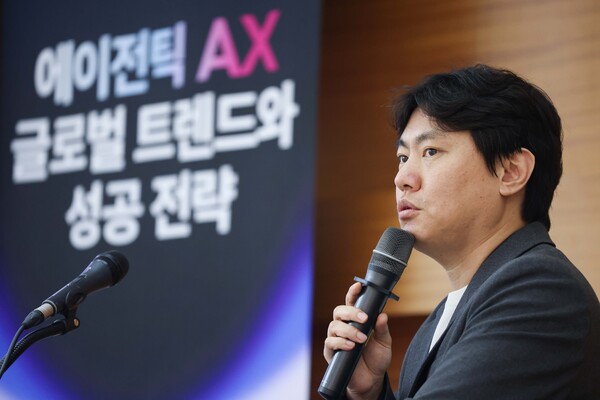
"Even if you use the same AI model, results differ. What makes the difference is not the model but data readiness."
Kim Ki-dong (김기동), a team leader at AI and data specialist Encoa, summed up on Sept. 29 why organisations see different results from adopting AI agents at the "Digital Insight 2026" conference held by DigitalToday at Coex in Seoul.
He said that for an agent to properly use corporate data, it must first be told what the data means and how it connects to other data.
Kim said many companies have adopted top-tier AI models and platforms and posted impressive results in proof-of-concept (PoC) and demo stages. But in real operations, AI agents often worked differently than expected.
The problem mostly surfaced in the process of linking existing data with AI in an actual operating environment. Because existing data structures are not designed for AI agents, agents that worked in demos end up failing to run properly in production.
Companies name tables in ways that are hard to recognise for security or operational purposes. Column descriptions are often missing or hard to understand. There are also many abbreviations used only within the organisation. Many also operate without indicating how tables connect because linking information can slow system speed.
When systems differ, there are also many cases where no linking information exists at all. That means how manufacturing execution system input data connects to enterprise resource planning system shipment data is left only in a person in charge's head or in design documents.
Kim said, "It is not that they do not do it because they do not know they can attach descriptions to data and define relationships. Legacy data structures make it difficult to do so." He added, "An AI model cannot create information that is not there. You must prepare in advance the information needed in the data AI will use."
Encoa redefined AI-ready data. Kim said, "People often think AI-ready data means clean, high-quality data, but that is only one of several conditions." He added, "AI-ready data must be data that AI can understand and trust."
The requirements for AI-ready data can be largely summarised into 3 points.
First is identifiability. The key point is that for an agent to find data, it must be able to tell what the data is. Next is relationship discoverability, meaning it must be able to tell how data is connected. Finally, context control means an agent should know only data that is permitted. Kim said, "Data must be managed so it is clear who can see up to what. That is how you can operate agents safely."
AI-ready data also differs from existing metadata. Metadata made for database management contains structural information such as whether tables and columns exist, whether standards are followed, and how far changes would affect things. Agents are different.
If existing metadata tells you what exists, agents are focused on asking what it means and how it is used. Kim said, "Before agents emerged, this kind of information was not particularly necessary. It was enough for the person in charge to know it from experience or to organise it in documents." He added, "(AI-ready data) is not about replacing existing metadata but about adding data meaning and linking information on top of it."
Encoa implemented this as a "context map". The company said the context map manages five items: data descriptions, names used in work (labels), purpose of use, relationship information and access rights. An agent uses vector search to find data with business terms and similar meaning, and uses graph search to follow links between data. It answers based on predefined meanings and relationships rather than guessing from table names.
Kim cited a situation where "customer preferred items" data becomes sensitive information. He said, "With an approach where rules are put into each agent, you have to fix all 10 agents. If you use a context map, you only fix one place. If you fix the definition, you do not have to fix the agents."
Finding the necessary data does not mean you get the answer. If you ask how far a specific material issue affected which items, the context map finds four related tables. But it cannot tell you in what order and under what conditions those four should be combined.
As a solution, Kim proposed a semantic model. A semantic model defines business terms such as "customer" and "order" in a single way and serves as a standard that links data corresponding to each term. Based on that, one side attaches meaning to metadata to build a metadata graph, or context map. The other side builds an instance graph that connects actual data according to business flow.
Kim said, "When finding data, you use the metadata graph. When making an answer, you use the instance graph. Both the metadata graph and the instance graph come from the same semantic model." He added, "AI models and technology will keep improving. What an agent uses and how it judges depends on what we have prepared."
 Chi-gyu Hwang
delight@d-today.co.kr
Chi-gyu Hwang
delight@d-today.co.kr