
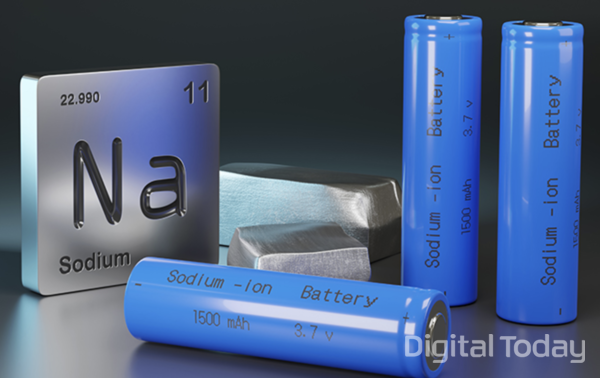
The focus of next-generation technology development in South Korea's battery industry is shifting from high-nickel (NCM) to sodium and all-solid-state batteries. That is because China has expanded its global market share with low-end (LFP) batteries and is also rushing commercialisation of sodium and all-solid-state batteries. The government, together with industry, released a "battery industrial technology roadmap" focused on supporting the two technologies and decided to create an R&D programme worth about 400 billion won over five years from 2027.
The Ministry of Trade, Industry and Energy on the 22nd released the public-private "battery industrial technology roadmap" at the Korea Chamber of Commerce and Industry in Seoul and decided to create an R&D programme worth about 400 billion won over five years from 2027. The government diagnosed that cost competition is intensifying in the global battery market amid slowing electric-vehicle growth and a pullback in support policies by major countries, compounded by supply-chain reshoring that prioritises domestic supply.
South Korean companies have so far focused on high-nickel, which has high energy density. The skew is most pronounced in the energy storage system (ESS) market. According to Benchmark Mineral Intelligence data cited by Hana Securities, LFP accounted for 92.1 percent of global new ESS installations in July. NCM, which South Korean companies have focused on, stood at 3.7 percent.
In the EV market, China-made EVs leave little room for South Korean battery companies to secure share. Eugene Investment & Securities analysed that while Europe’s EV sales growth rate will reach 25 to 30 percent this year, South Korean battery makers are not benefiting because of a surge in exports of China-made EVs. As of the end of August, Chinese brands’ share of the European auto market is estimated at 11 percent, while the share of hybrids including plug-in hybrids (PHEVs) is estimated at more than 30 percent. That is seen as a backdrop to South Korean companies turning to next-generation technology as it becomes harder to compete in the low-end market in the same way as China.
The roadmap sets 2030 as the commercialisation target for both technologies. The ministry plans to develop sodium batteries to the 220 Wh/kg level by 2030 and commercialise them. It plans to complete development of all-solid-state batteries at the 400 Wh/kg level in 2028 and then commercialise them in 2030. Sodium batteries target low-end EVs and ESS because they are cheaper than lithium and carry lower supply-chain risk. All-solid-state batteries are used for high-performance EVs and robots, drones and urban air mobility (UAM) by raising energy density and safety.
The burden of development through 2030 is shared by cell makers and materials companies. The roadmap calls on the three cell makers, LG Energy Solution, Samsung SDI and SK On, to reduce overlapping investment by presenting joint specifications in non-competitive areas such as standards. From 2027, the roadmap also begins tasks in which cell makers verify and purchase materials once materials companies develop materials that meet target performance and price. The private sector also decided to execute about 8 trillion won in R&D and facility investment through 2030 for process innovation, development of low-cost materials and localisation of imported materials.
Until 2030, LFP will support revenue... Cathode suppliers secure a series of ESS supply deals
Cathode makers are filling revenue needed to hold out until 2030, the roadmap’s commercialisation target, with current orders for LFP cathode materials. L&F on the 17th signed an LFP cathode material supply contract with SK On worth about 160 billion won. The supply volume goes into LFP cell production lines for ESS at SK On’s Seosan plant in South Chungcheong Province and its plant in Georgia in the United States. The contract runs through the end of 2028, and the two sides decided to discuss an extension of up to 3 years. If extended, the supply relationship continues beyond the roadmap’s commercialisation target.
POSCO Future M switched a line that had been making high-nickel cathode materials to LFP. The company said it converted part of a high-nickel cathode material production line at its Pohang plant for LFP and will start mass-production supply from the end of this year. It agreed with a South Korean battery company to supply more than 190,000 tonnes of LFP cathode materials over 6 years from 2027 to 2032. As the roadmap prepares for 2030, plant lines are changing to match current demand.
As the battery roadmap cites ESS as a use for sodium, customers buying sodium batteries in 2030 overlap with customers buying LFP today. The variable that is seen as determining the roadmap’s performance is whether cathode makers can extend supply relationships forged with cell makers while holding out with LFP through the materials-cell verification tasks and into sodium commercialisation. An industry official said, "As ESS demand grows, LFP will be the main source of revenue for the time being," adding, "(Sodium, all-solid-state and others) will start to switch only after the target point if prices fall below the LFP level."
 Dae-geon Seok
d2dg@d-today.co.kr
Dae-geon Seok
d2dg@d-today.co.kr