
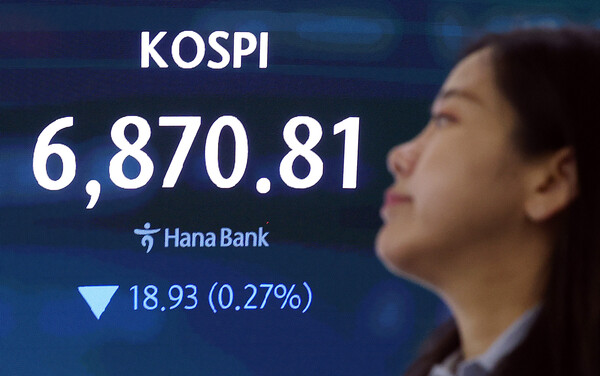
[DigitalToday reporter Sangyeop Oh] South Korea's KOSPI fell for a second straight day on Sept. 29 as foreigners logged net selling of nearly 3 trillion won. The index slid to the 6,780 level during the session on higher U.S. long-term yields and worries about a slowdown in artificial intelligence (AI) investment. It later recouped most of its losses as bargain buying emerged in some semiconductor shares, including Samsung Electronics.
The KOSPI ended down 18.93 points, or 0.27 percent, at 6,870.81. It opened down 45.33 points, or 0.66 percent, at 6,844.41. The index sank to the 6,700 level as selling intensified early, then rebounded to close around 6,870.
In the main bourse, foreigners net sold 2.9043 trillion won. Retail investors and institutions net bought 1.1450 trillion won and 120.6 billion won, respectively.
Top market-cap shares were mixed. Samsung Electronics rose 0.93 percent to close at 272,500 won, paring some of the previous day's drop of more than 5 percent. SK Hynix slipped 0.17 percent to 1,765,000 won.
SK Square rose 1.64 percent and Samsung Electro-Mechanics gained 1.93 percent. LG Energy Solution fell 3.16 percent, while Hyundai Motor dropped 1.27 percent and Samsung Biologics fell 1.07 percent. KB Financial Group slipped 0.40 percent and Samsung Life lost 1.86 percent.
The KOSDAQ ended higher. It added 3.22 points, or 0.38 percent, to 849.80.
In the Seoul foreign exchange market, the won was at 1,357.90 per dollar, up 2.10 won from the previous session.
Overnight losses on Wall Street weighed on local shares as long-term yields rose and AI-related stocks weakened. The yield on the U.S. 10-year Treasury note climbed to 5.236 percent. The Nasdaq index fell 0.92 percent and the Philadelphia Semiconductor Index lost 1.61 percent. Meta and Micron fell 4.79 percent and 2.61 percent, respectively.
Concerns over a slowdown in AI investment resurfaced after reports said OpenAI temporarily halted training of its latest model over safety issues.
Han Ji-young (한지영), a researcher at Kiwoom Securities, pointed to the potential for losses to narrow during the session due to bargain buying driven by perceptions that the index decline was excessive. He also said volatility could persist ahead of key events this week, including Micron earnings, U.S. jobs data and South Korea's exports.
 Sangyeop Oh
yub@d-today.co.kr
Sangyeop Oh
yub@d-today.co.kr