
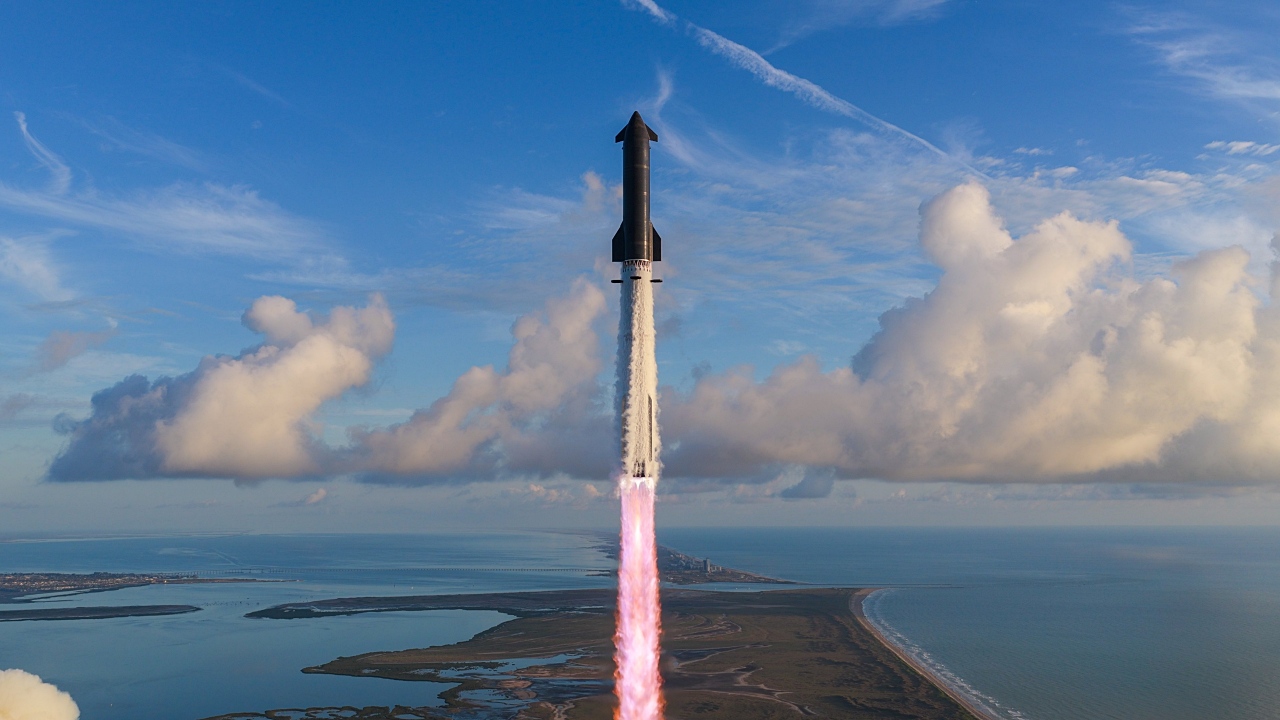
[DigitalToday reporter Hyunwoo Choo] SpaceX has succeeded in the first orbital flight of Starship, its next-generation heavy-lift launch vehicle. Starship lifted off on the 28th (local time) from Starbase in Texas, entered orbit, deployed 26 Starlink V3 satellites and then returned to Earth, space news outlet Space.com reported.
Starship launched at 8:48 a.m. Eastern time. There was a slight delay, but 25 minutes after launch the upper-stage spacecraft briefly ignited 1 Raptor engine to reach low Earth orbit. Starting about 34 minutes after launch, it released 26 satellites in sequence over 30 minutes. Three of them carried cameras to film the spacecraft's heat-shield tiles. The first-stage Super Heavy booster made a controlled splashdown in the Gulf of Mexico 7 minutes after launch. This time, SpaceX did not attempt a recovery by catching the booster with the launch tower’s robotic arms.
There was also an unexpected issue. One of the 6 upper-stage engines shut down during liftoff, and SpaceX at one point announced it was aborting the mission. The control team reversed that decision and continued the flight. A SpaceX spokesperson said, "We haven't given up yet." Some engines on Super Heavy also shut down during flight, but it did not affect the splashdown. The spacecraft remained in orbit for about 8 more hours before splashing down in the Pacific Ocean off Chile. The full flight lasted about 9 hours and 50 minutes. Elon Musk (일론 머스크), SpaceX's chief executive, wrote on social media: "Starship first orbital flight success."
This launch is seen as significant because it was the first time Starship carried a paid payload. Starlink is a core business that accounted for most of SpaceX revenue last year. SpaceX has submitted a plan to increase its Starlink satellites from about 11,000 to 100,000. It assumes that Starship, much larger than Falcon 9, will carry V3 satellites in large volumes.
SpaceX executives estimate that fully reusable Starship can cut launch costs to as low as one-tenth of Falcon 9. Musk has said it could be possible to launch once a day within a year. SpaceX plans to use Starship for a concept to launch up to 1 million satellites that would serve as an orbital data centre and for plans to settle the Moon and Mars.
 Hyunwoo Choo
cookinpapa@d-today.co.kr
Hyunwoo Choo
cookinpapa@d-today.co.kr