
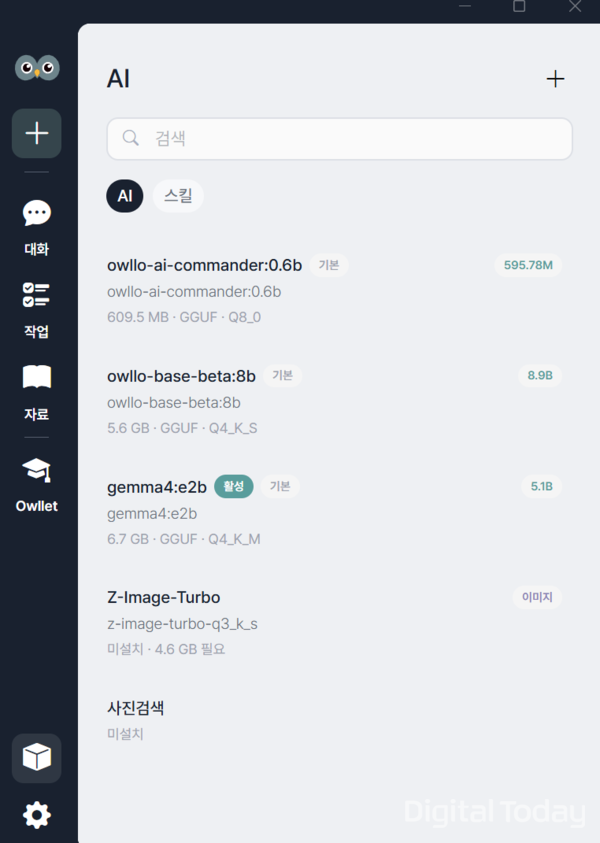
Weekley is adding functions such as agents, skills and natural-language photo search to its local AI platform Owllo. It is also widening its service scope by linking it with its e-paper display hardware, Paper.
Weekley is developing Owllo, which enables users to run open-weight large language models on a personal computer. It is designed to let users use multiple local AI models without having to install models themselves or set up operating environments such as terminals and API keys one by one.
It has added more functions than in the early beta stage. Owllo now lets users choose which AI model to use and separate general conversation from agent execution. It has also added skills that can be used for email, calendars, file organisation and web searches, with separate functions for task and material management.
Owllo runs open-weight models on a user's PC and does not charge usage fees for tasks processed locally. Weekley reduced the installation and configuration process so that users who find it difficult to handle open-weight models directly can also use local AI.
It has recently strengthened functions that use data stored on a personal computer. With natural-language photo search, users can find an image with a sentence such as "photos taken on a clear day on last year's trip" even if they do not know the file name or the date the photo was taken.
The use of personal data is why Weekley believes demand for local AI will continue. To use personal documents or photos in cloud AI such as ChatGPT or Claude, data must be sent to an external server. There is also the inconvenience of uploading materials of tens of gigabytes in size, such as photos, every time.
Owllo uses local models and cloud AI together depending on the task. It handles relatively simple tasks with lightweight models, and calls up another local model installed on the PC if higher performance is needed. If processing is difficult locally, it calls external cloud AI via an API after obtaining user consent.
Woo-seok Seo (서우석), Weekley's chief technology officer, said uploading tens of gigabytes of data such as personal photos outside every time is inconvenient, and there may also be reluctance to hand sensitive data to external operators. He said local AI is unlikely to fully replace frontier models, so it should be viewed as a complementary relationship in which cloud AI is also used when necessary.
Weekley is also expanding its local AI business into hardware. It is preparing to launch its 10-inch colour e-paper display, Paper, in the United States. It was developed as a secondary display that shows information such as photos, schedules and weather in living spaces.
It plans to link Owllo and Paper so that AI processes user-specific information such as schedules and photos and then displays it on the Paper screen.
Juhyun Yoon (윤주현), Weekley's chief executive, said regardless of how AI operates, the output should be something users can see or touch. He said Paper is a product intended to let people use AI-generated results in living spaces.
 Seulgi Son
sageson@d-today.co.kr
Seulgi Son
sageson@d-today.co.kr