
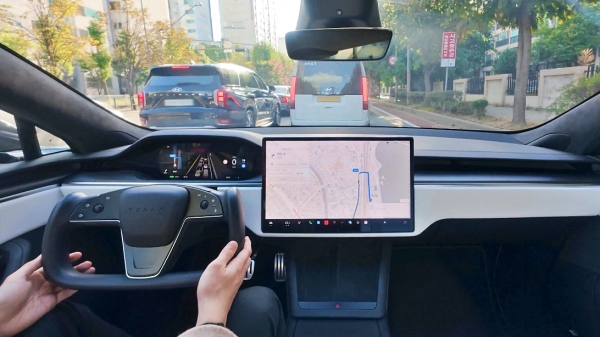
A debate is growing again over the safety and commercial rollout of Tesla's driver assistance system, FSD (Full Self-Driving). Tesla recently changed policy on some new cars by removing a lane-centering feature from standard equipment and steering buyers toward FSD subscriptions, raising questions about charging $99 a month, or about 130,000 won, for a safety-related function.
CleanTechnica reported on Sept. 25 that the latest controversy is focusing less on FSD's technology level than on how it should be provided to consumers.
Tesla currently offers FSD under the name "FSD Supervised". As the name suggests, it is a driver assistance system that requires drivers to continuously monitor driving conditions. Tesla also says the system is not fully autonomous driving technology and that driver attention is required.
Even so, assessments of FSD differ widely. The CleanTechnica author argued that if FSD advances sufficiently, it could help reduce traffic deaths. Elon Musk also argued in April that if FSD becomes much safer than human drivers, it could significantly reduce global traffic deaths.
Debate continues over FSD's current real-world safety. The author described an experience in June in Madison, Wisconsin, where he intervened while driving a 2018 Model 3 on FSD, ran through a stop sign and later collided with another vehicle. He argued that if he had let FSD continue driving, it might have stopped instead.
This single case cannot determine FSD's overall safety. As reports continue that Tesla FSD has been involved in crashes, critics also point to a lack of sufficient public data to comprehensively compare the system's accident rate and safety versus human drivers.
Tesla currently equips new cars produced since mid-2023 with camera and computer hardware capable of running future FSD functions. Tesla is collecting vast driving data and continuing training using a supercomputer, while also spending heavily on ongoing software improvements.
For this reason, there is an argument that running FSD as a subscription service helps recover development costs and secure revenue to keep improving the technology. Tesla's decision to provide FSD for a $99 monthly fee aligns with that business structure.
Still, controversy remains over whether a function directly tied to safety should require a separate charge. CleanTechnica raised the issue by citing how seat belts moved from optional equipment to a basic safety device, questioning whether autonomous driving technology should also become standard equipment once it reaches a certain level.
There are also positive assessments of FSD's current performance. Based on using FSD V14 for four months in a new Model Y, the author said it has reached a fairly high level on highways. He also offered a 전망 that the next version, V15, could come close to removing the current "Supervised" condition for highway driving.
Problems remain for city driving. Errors can occur in lane choice at traffic lights, parking, and in starting and finishing a drive. In the end, there is still much to verify before concluding that FSD is safer than human drivers in all situations.
Approaches also differ among companies. Tesla sticks with a camera-centered, vision-based system, but other autonomous driving companies and automakers are using lidar and radar together. Some assessments say using multiple sensors can be advantageous in bad weather or limited visibility. A camera-centered approach, by contrast, can lower hardware configuration and vehicle deployment costs.
Looking ahead, the central issue surrounding FSD ultimately depends on how objectively its safety can be proven. If sufficient data proves it is meaningfully safer than human drivers, the debate over making FSD standard equipment and over pricing policy could enter a new phase.
Another variable is the scope of application to existing vehicles. How broadly FSD functions will be offered to vehicles with the latest hardware, and whether to convert it into a basic function without a separate subscription fee, are expected to be future points of contention.
Tesla has already expanded its technology as an industry standard by opening its Supercharger network to other automakers. Attention is on whether FSD, if its reliability and safety are sufficiently proven, can move beyond a paid option and become a basic vehicle function.
 Jinju Hong
hongjj@d-today.co.kr
Jinju Hong
hongjj@d-today.co.kr