
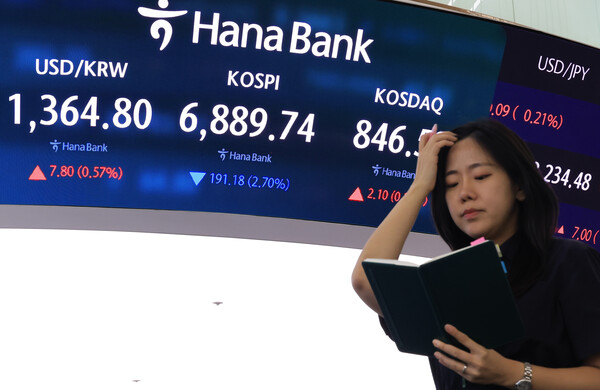
[DigitalToday reporter Oh Sang-yup (오상엽)] The KOSPI on the 28th slid more than 2 percent to below the 6,900 level on heavy foreign selling and weakness in major chip stocks such as Samsung Electronics and SK Hynix. The burden from a sharp rise in U.S. long-term yields over the holiday period persisted, and the index ended near its intraday low as foreigners and institutions sold at the same time.
The KOSPI closed down 191.18 points, or 2.70 percent, at 6,889.74. It opened down 23.06 points, or 0.33 percent, at 7,057.86. Losses widened from early trading and the index fell as low as 6,889.68, dropping below 6,900.
In the main board market, foreigners net sold 32.3 billion won. Institutions also dumped 10.2 billion won. Retail investors net bought 26.0 billion won, taking the supply.
Among the top stocks by market value, chip-related shares fell sharply. Samsung Electronics closed down 5.25 percent at 270,500 won and SK Hynix dropped 4.83 percent to 1,772,000 won.
Other stocks including SK Square fell 7.90 percent, Samsung Electro-Mechanics slipped 0.86 percent and Samsung Life declined 0.17 percent.
LG Energy Solution, meanwhile, ended up 3.13 percent at 362,500 won. Hyundai Motor rose 0.28 percent, Samsung Biologics gained 2.12 percent and KB Financial Group added 0.35 percent.
The Kosdaq, unlike the KOSPI, ended higher. The Kosdaq index gained 2.10 points, or 0.25 percent, to 846.58.
In Seoul's foreign exchange market, the won was 1,363.30 per dollar, down 4.30 won, or 0.32 percent, from the previous session.
South Korean stocks are seen as reflecting at once the burden from rising U.S. long-term yields and increased volatility in global stock markets over the holiday period. During the market closure on Sept. 23 to 25, the U.S. 10-year Treasury yield rose as high as 5.2 percent intraday. Over the same period, the Nasdaq index fell a cumulative 0.6 percent and the Philadelphia Semiconductor Index slipped 0.2 percent.
In particular, foreign selling focused on major chip stocks such as Samsung Electronics and SK Hynix, widening the index's decline. South Korean stocks last week rose, with the KOSPI up 2.71 percent on strong chip export data and expectations of increased investment in artificial intelligence, but chip shares underwent a broad correction on the day, giving back part of the gains.
Han Ji-young (한지영), a researcher at Kiwoom Securities, said the stock market will face uncertainty again this week over rising U.S. long-term yields, but expected recovering leadership by AI infrastructure shares such as chips driven by agent AI to provide upward momentum for equities.
 Oh Sang-yup
yub@d-today.co.kr
Oh Sang-yup
yub@d-today.co.kr