
French photonic quantum computing company Quandela announced a Korea business strategy focused on finding strategic local partners and pursuing joint development over the next two years, along with a mid- to long-term technology roadmap to implement fault-tolerant quantum computing (FTQC).
Quandela said at a press briefing on Sept. 28 that it will seek strategic partners in South Korea and push joint development and technical cooperation over the next two years in three areas: photonic quantum hardware manufacturing, cryogenic control and system integration, and operation of quantum systems based on AI, GPUs and high-performance computing (HPC).
It is a strategy to build a cooperation structure that runs from hardware manufacturing to system integration, demonstration and verification, and actual operations.
In quantum chip manufacturing, it will cooperate around heterogeneous integration technologies for photonic integrated circuits (PIC), electronic integrated circuits (EIC), single-photon sources and superconducting nanowire detectors. It plans to develop photonic modules that can verify suitability for mass production by using local capabilities in advanced semiconductor packaging, wafer-level testing and precision optical alignment, and to prepare a joint manufacturing roadmap.
In system integration, it will build a low-latency control demonstrator and an integrated test environment centered on a 2 to 4K-class cryogenic platform, real-time feedforward and high-speed control electronics. In operations, it will jointly develop error-correction decoding, AI-GPU linkage, and HPC-cloud integration technologies, and pursue a QPU-HPC integration proof of concept (PoC) in South Korea.
Quandela also presented a direction for forming a quantum manufacturing consortium involving Korean companies and research institutes. Quandela will share its technology and system roadmap and its experience deploying and operating QPUs in Europe, while local partners take on semiconductor, photonics, advanced manufacturing and system integration capabilities.
Under the principle, each institution retains its existing intellectual property (IP), and newly created IP is shared according to roles and level of contribution. It will also review participation in related projects such as the government's quantum manufacturing challenge. Quandela also disclosed a mid- to long-term technology roadmap to implement FTQC. It plans to combine semiconductor spin technology and error-correction functions with a photonic QPU, then gradually expand system scale and computing performance to develop into an FTQC environment capable of long, complex computations.
Quandela deployed its photonic QPU, Lucy, at France's large-scale computing center TGCC in October 2025 and is supporting a hybrid workflow combining HPC and quantum computing by linking it with the Joliot-Curie supercomputer. In South Korea, it plans to combine that operational experience with local capabilities in semiconductors, photonics, AI and advanced manufacturing to identify industrial application cases and expand joint development opportunities.
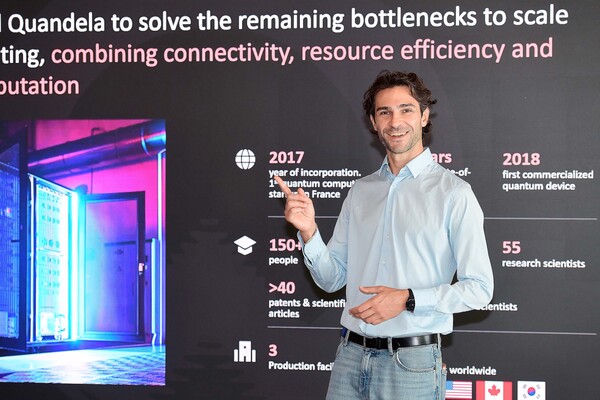
Quandela CEO Niccolo Somaschi (니콜로 소마스키) said, "Scaling performance of photonic quantum computers ultimately depends on semiconductor-level precision manufacturing and inspection capabilities." He said, "Over the next two years, we will find local partners, review the mass-production suitability of photonic modules, and reflect the results in the technology roadmap toward error-corrected quantum computing." He added, "We will create practical cooperation cases with Korean companies and research institutes and, in the long term, develop South Korea into a key hub for cooperation in the Asian region."
 Chi-gyu Hwang
delight@d-today.co.kr
Chi-gyu Hwang
delight@d-today.co.kr