
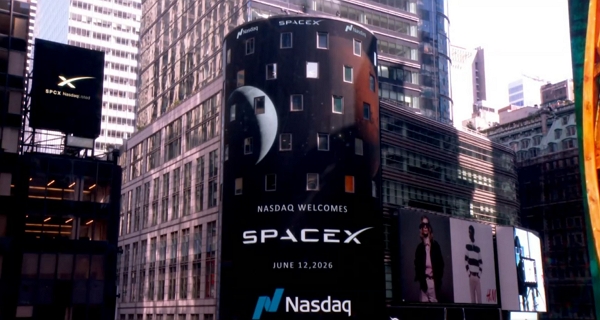
[DigitalToday reporter Jinju Hong (홍진주)] Exchange-traded funds (ETFs) tracking the space industry are showing differing investment characteristics in 2026. In particular, after SpaceX’s listing, return structures and volatility have diverged sharply depending on portfolio weights. That has made it harder to judge a product’s features based only on the “space ETF” label, an analysis shows.
Blockchain media outlet Cryptopolitan reported on Sept. 25 that the biggest recent shift in the space ETF market is the weight of SpaceX. In the past, products broadly held satellite, communications, navigation, defence and aerospace companies. Among some recently launched ETFs, however, large SpaceX positions have created structures that are sensitive to moves in a single stock’s price.
Major space ETFs include Procure Space ETF (UFO), Theme Space Innovators ETF (NASA), Roundhill Space and Technology ETF (MARS), ARK Space Exploration & Innovation ETF (ARKX) and VanEck Space Innovators UCITS ETF (JEDI). All focus on the space industry as a key investment target, but their actual portfolios differ considerably.
UFO, launched in 2019, maintains a relatively diversified portfolio. As of September 2026 it holds 52 stocks. Garmin has the largest weight at 6.78%, followed by Trimble at 6.75%, SiriusXM at 5.55%, Viasat at 5.44% and SpaceX at 5.07%. The top 10 holdings account for more than 48%, but dependence on any single stock is relatively low.
NASA, listed on the New York Stock Exchange on March 30 this year, has a more concentrated structure. As of September 2026, assets under management rose to $1.01 billion. Among 36 holdings, SpaceX had the largest weight at 25.5%. Rocket Lab followed at 9.94%, with AST SpaceMobile at 6.86% and Viasat at 5.62%. SpaceX and Rocket Lab together account for more than 35%.
MARS is also considered among a new generation of space ETFs with high reliance on SpaceX. SpaceX accounts for 25.54%, followed by Rocket Lab at 9.26%, AST SpaceMobile at 6.94%, Viasat at 5.06% and Globalstar at 5.04%. It invests across the space industry, but returns could be significantly affected by key holdings, especially moves in SpaceX shares.
ARKX, launched in early 2021, is relatively closer to a mixed approach. As of September 2026, assets under management are $759.5 million and SpaceX accounts for 10.165%. L3Harris Technologies has a 6.83% weight, followed by Kratos Defense & Security Solutions at 6.42%, Deere at 5.37% and Rocket Lab at 4.89%. It also includes some big technology stocks such as Amazon and Nvidia, meaning it can reflect moves in tech stocks as well as the space industry.
UCITS products that follow European regulations appear relatively diversified. JEDI, launched in June 2022, has $1.7 billion in assets under management as of September 2026. Key holdings are Viasat at 9.56%, EchoStar at 7.28%, Globalstar at 6.52% and Rocket Lab at 6.31%. Direct concentration in SpaceX is lower than in some newer U.S. ETFs.
Differences among products are not easy to identify from fees alone. These ETFs generally have management fees of 0.50 to 0.75%, but what determines the actual risk structure is the weight of individual holdings. While existing ETFs broadly held satellite, communications, defence and aerospace infrastructure, newer ETFs tend to put heavier weights on some growth stocks including SpaceX.
Investors also need to check whether they have indirect exposure to unlisted companies. For products that provide equity exposure to companies before they list, liquidity can be limited compared with typical listed-stock investments. The timing of actual price formation can also be delayed. As a result, there is a risk that invested funds could be locked up for a certain period.
Concentration in specific holdings is also cited as a major risk factor for space ETFs. If weights in certain names such as SpaceX become excessively high, performance can be heavily influenced by a single company’s stock price even in an ETF that invests in multiple firms. For new ETFs without sufficient trading volume, price volatility could also increase depending on market conditions.
Ultimately, in the space ETF market, actual portfolio composition matters more than the “space” theme itself. To understand each product’s investment characteristics, investors need to look at SpaceX weight, top holdings, the number of holdings, management approach and structural differences between U.S. ETFs and UCITS products.
Even ETFs that promote the same space-industry theme can have different price moves and risk exposure depending on what they hold and in what amounts. As a generational shift in the space ETF market unfolds around SpaceX, that is why some point to the need to check portfolios first, not product names.
 Jinju Hong
hongjj@d-today.co.kr
Jinju Hong
hongjj@d-today.co.kr