
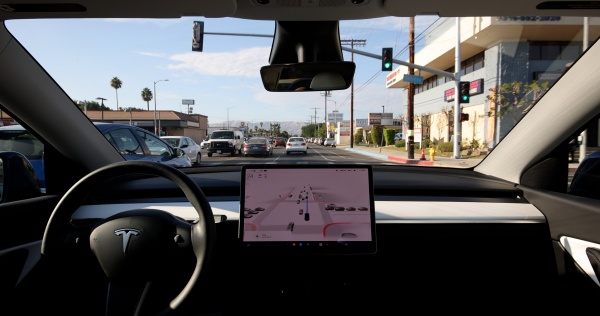
[Digital Today reporter Jinju Hong] A vote to approve an expanded rollout of Tesla’s supervised Full Self-Driving (FSD) in Europe has been postponed until at least December.
On Sept. 25 (local time), EV outlet Electrek reported that the European Union will not vote on Tesla’s FSD at the Technical Committee on Motor Vehicles (TCMV) meeting on Oct. 6. It will instead hold an additional 25-minute discussion on a request from the Netherlands.
A draft agenda for the 119th TCMV meeting released by the European Commission’s Directorate-General for Internal Market, Industry, Entrepreneurship and SMEs (DG GROW) lists the item as “continuation of discussions on the Netherlands’ request for Article 39 approval.” The slot is scheduled for 11:45 a.m. to 12:10 p.m., and does not include Tesla’s name or any voting item. With the next TCMV meeting set for December, that is now the earliest timing for an EU-level vote on Tesla’s FSD.
The disputed Article 39 provides a route to exceptionally approve new technologies that do not fit existing regulations. The Dutch regulator RDW used the provision in April to approve supervised FSD in the Netherlands, and has since asked the Commission to expand that national approval across the European Union.
The delay also conflicts with the timetable Tesla has presented. Tesla Europe posted on X on Sept. 1 that FSD had been approved in five European countries and was being used by more than 70,000 customers, adding that an EU-wide vote could take place on Oct. 6. But the actual agenda does not include a vote.
The approval process does not end with a simple majority of member states. For the Dutch request to pass, at least 15 of the EU’s 27 member states must vote in favour, and their combined population must account for at least 65 percent of the EU total. So far, Denmark, Belgium, Estonia, Lithuania, Slovenia and the Czech Republic have recognised the Dutch approval domestically. That makes seven countries including the Netherlands, but their population share totals about 12 percent.
Opposition arguments also remain in place. Sweden said FSD should not be accepted unless Tesla removes a function that allows the system to be set to exceed the speed limit. Nordic regulators also raised issues about icy-road conditions and maintaining driver attention. France did not recognise the Dutch approval, citing speeding in urban driving and driver-attention concerns.
Recent external test results are also weighing against Tesla. A pedestrian safety group in Brussels said this week that tests conducted in countries that have already approved the system found FSD exceeded the limit in 55 percent of zones with a 30 km per hour limit.
The outcome of the vote depends on the positions of major large countries. France already opposes it, and Germany, Italy and Spain have not yet recognised the Dutch approval. Those four countries account for about 58 percent of the EU population. As a result, if Tesla fails to win over even some of them, meeting the 65 percent threshold will be effectively difficult.
Tesla expected Dutch approval around February 2026, but RDW denied that in November last year. The target was later moved to April 10, and approval in the Netherlands did occur. But a Europe-wide launch projected for the summer of 2026, mentioned by Elon Musk, did not lead to a vote in the TCMV discussions in June, and has been delayed again this time. Expanding FSD in Europe now requires resolving regulatory conflicts over speed limits and the obligation to maintain driver attention before it can move to the next stage.
 Jinju Hong
hongjj@d-today.co.kr
Jinju Hong
hongjj@d-today.co.kr