
MachinaRocks said on Sunday it applied its AI operating system, Runway, to the Korean Joint Command and Control System (KJCCS) together with the Joint Chiefs of Staff and validated it in an actual military operating environment during the 2026 Ulchi Freedom Shield (UFS) exercise period.
KJCCS is a key command-and-control system that supports joint operations. The battlefield network on which KJCCS runs is a closed network with a higher level of security controls than the defence network that handles administrative, logistics and personnel work. Stricter technical and security requirements are required when introducing external technologies such as generative AI.
MachinaRocks said it built infrastructure to develop and operate AI models and services inside KJCCS through a project to demonstrate information search and operational technology for applying generative AI to KJCCS. Based on Runway 2.0, it enabled AI models and data to be managed and operated even in an environment separated from the external internet.
The military operated its self-developed AI service, GeDAI J, in the environment. MachinaRocks also developed and applied an AI function that can search materials accumulated in KJCCS using natural language. When a user asks a question, it finds relevant materials and provides answers along with sources.
The AI infrastructure and services that were built were verified in an actual military operating environment during the UFS exercise period. The military used AI functions including GeDAI J for operational tasks at the exercise site and checked whether generative AI could be operated in a closed-network environment and its practical usability.
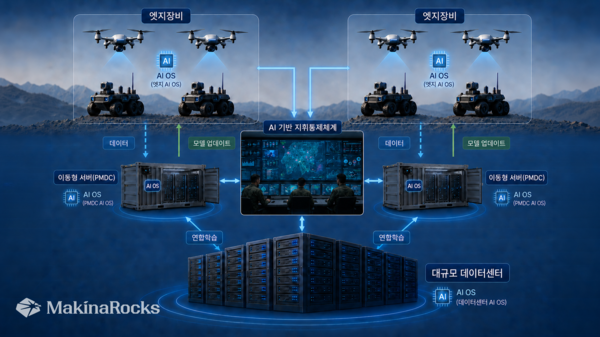
MachinaRocks explained that the environment built this time can be expanded into a distributed AI operations structure that connects not only a central data centre but also mobile servers and edge equipment at operational sites. In the structure, data generated in the field is reused for AI model training and advancement.
Through this, the plan is to lay the foundation for operations that are not tied to a specific AI model, allowing the military to add and replace AI models and services according to its own data and needs.
MachinaRocks is pushing to build generative AI infrastructure and services in the defence sector, including applying an AI assistant that supports the operation of ship equipment at the Navy's 1st Fleet Command ahead of the pilot application to KJCCS.
Yoon Sung-ho (윤성호), chief executive of MachinaRocks, said the battlefield network is among the most difficult areas to apply AI technology because it requires a high level of security and an independent operating environment. He said the pilot application laid the groundwork for operating the military's own AI models in KJCCS and verified the potential for use in an actual military operating environment through the UFS exercise.
 Seul-gi Son
sageson@d-today.co.kr
Seul-gi Son
sageson@d-today.co.kr