
[DigitalToday Seung-ah Yoo, intern reporter] Hyundai Motor Group reaffirmed its position that it will continue pushing ahead with the development of all-solid-state batteries.
From startups to major automakers, companies are continuing to invest in all-solid-state batteries, touted as a “dream technology” to deliver ultra-fast charging and longer driving range for electric vehicles (EVs). At the same time, the performance of conventional lithium-ion batteries is improving quickly. Geely’s latest battery technology takes less than 9 minutes to charge from 10 percent to 97 percent. Even so, is there still a need to keep developing all-solid-state batteries?
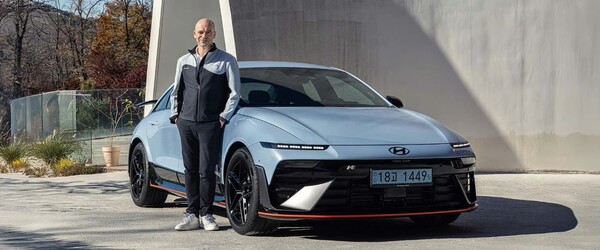
On Sept. 27 (local time), EV-focused outlet InsideEVs reported that Hyundai Motor Group R&D chief Manfred Harrer (만프레드 하러) gave a firm “yes” to that question.
Harrer told reporters last week, “We cannot give up now. That is clear,” adding, “We must be part of this competition.”
Current EV batteries use a liquid electrolyte to move lithium ions between the cell’s anode and cathode. All-solid-state batteries, by contrast, mainly replace that liquid electrolyte with a solid material such as ceramics or polymers. This could raise both safety and performance. But no company has yet succeeded in producing solid-state cells at a scale suitable for automobiles.
Harrer cited smaller batteries, improved fast-charging performance and longer driving range as potential advantages of all-solid-state batteries. He forecast that a symbolic vehicle produced in small volumes with an all-solid-state battery would appear within the next 5 years. QuantumScape is also aiming to apply all-solid-state batteries to high-performance vehicles by the late 2020s.
Raw material costs are expected to remain very high for years as the technology scales up. Harrer said this would make it difficult for all-solid-state batteries to enter the mass market. “In the end, you can solve everything, but it costs money. It comes at an enormous cost,” he said.
Hyundai is developing all-solid-state batteries in-house while also working with partners such as Solid Power. Harrer described all-solid-state batteries as “the industry’s big bet right now.” Toyota has been developing all-solid-state batteries for at least 20 years and is targeting mass production within the next few years. Volkswagen is making large-scale investments in QuantumScape, while BMW is working with Solid Power. General Motors, Ford, Honda and Nissan are also moving into all-solid-state battery development.
Some companies have already unveiled demonstration prototypes. Examples include a Ducati equipped with QuantumScape cells and a Mercedes vehicle using Factorial’s technology. But there are still no cases of all-solid-state batteries being fitted in mass-produced vehicles that consumers can actually buy.
Harrer’s goal is for Hyundai to enter the market with its own supply chain and manufacturing capabilities once the technology matures. “We want to be the owner of this key technology,” he said. “That is why we are also investing in our own battery manufacturing.”
Harrer explained that it is important to deeply understand battery manufacturing methods and the associated costs. Batteries are the most expensive component in EVs and are also used in other electrified vehicles. Hyundai plans to apply its in-house nickel·manganese·cobalt (NCM) cells to the extended-range electric vehicle (EREV) version of the Tafe, which is scheduled to launch early next year. In a recent announcement, Hyundai said it plans to launch the Tafe EREV in the first half of 2027.
All-solid-state batteries are expected to take considerable time before reaching the mass market. “I do not think we can solve the raw material cost issue within 5 years from now,” Harrer said.
 Seung-ah Yoo
ysah@d-today.co.kr
Seung-ah Yoo
ysah@d-today.co.kr