
With the AI Basic Act taking effect, South Korea will introduce an “AI product verification certificate” scheme aimed at lowering barriers for AI companies entering the public market. Attention is on whether it will help AI startups with no public delivery experience enter the procurement market.
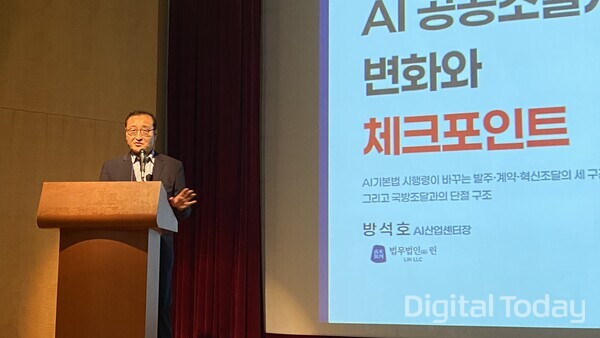
Bang Seok-ho (방석호), head of the AI Industry Center at law firm Lin, said at a seminar titled “Are you preparing for the AI Basic Act?” hosted by Selectstar on Sept. 17 at Posco Tower Yeoksam in Seoul that the certificate is not a certification but an alternative way to prove technical requirements in procurement procedures. He said it creates another door into the public procurement market.
The AI product verification certificate is a scheme to confirm technical requirements for AI products and services in public procurement. It focuses on checking whether AI is actually used in a product.
The Korea AI and Software Industry Association (KOSA) will accept applications and issue certificates, and the Telecommunications Technology Association (TTA) will conduct technical reviews. The process takes up to 45 days, including any extension period.
AI products holding the certificate will receive partial easing of existing entry requirements during public procurement contracting. The delivery performance requirement, which was mandatory when listing commercial software under third-party unit price contracts, will be reduced to 0 cases from 3, and credit rating grades will be waived in eligibility evaluations.
In competitive bidding, products with the certificate will receive an additional 1.5 points in the technical score under the reliability item of the eligibility review. Bang said eligibility reviews are often decided by differences in decimals, making 1.5 points a significant score.
Requirements for multiple-award schedule (MAS) contracts related to AI product procurement have also been eased. Previously, there had to be at least 3 suppliers of the same item, but the threshold was lowered to at least 2 companies from August, and company-proposed specifications are allowed in place of standard specifications, making it easier to purchase early-stage AI products.
The AI certificate does not certify a product’s quality, security or reliability. The TTA technical review is a substantive review that checks whether AI is actually used in product and service functions, and it does not guarantee accuracy, security, or suitability for public work.
Bang said not everything is recognized just because a company has obtained a certificate and that it must ensure compliance with existing laws and regulations more thoroughly. He said, for example, supplying to security systems requires related procedures such as National Intelligence Service security screening in addition to the certificate.
Bang also said AI is not a product that can be finished with a one-off inspection and that contracts must clearly specify who bears data update costs and who is responsible if security problems arise later.
 Seulgi Son
sageson@d-today.co.kr
Seulgi Son
sageson@d-today.co.kr