
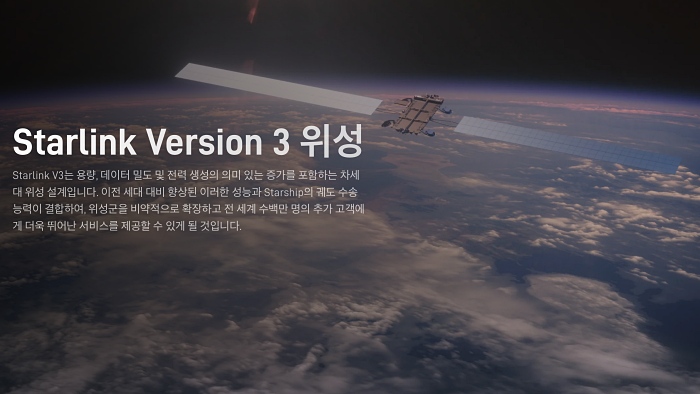
Elon Musk (일론 머스크), CEO of SpaceX, said the company will begin deploying its third-generation communications satellite, Starlink V3, this month.
On Sept. 16 local time, Musk wrote on his social media platform X that deployment of the Starlink V3 constellation would begin this month. He said it would ultimately provide more than 100 times the bandwidth of the current 11,000-satellite constellation.
The comments are seen as aimed at the 14th test flight of the super-heavy rocket Starship, scheduled for Sept. 22. In the flight, Starship plans to enter Earth orbit for the first time and make six laps around the planet over about 10 hours, placing 26 Starlink V3 satellites into orbit.
Starlink V3 is SpaceX's third-generation communications satellite. SpaceX has not officially disclosed specifications, but Musk said at an earnings briefing in May that the satellite's size was "at the level of a Boeing 737 passenger plane." Depending on the generation, Boeing 737 models have a length of 28 to 42 metres. Foreign media have reported that Starlink V3, with its solar panels deployed, is known to have a length exceeding 60 metres. When folded, it was reported to be about 7 metres long and to weigh about 2 tonnes.
SpaceX previously succeeded in a test during Starship's 10th test flight in August last year, deploying and releasing eight Starlink V3 mock satellites at about one-minute intervals.
Starlink V3 uses a new phased-array antenna to deliver maximum uplink speeds of 160 Gbps and maximum downlink speeds of 1 Tbps. That is about 22 times faster on the uplink and about 10 times faster on the downlink than the existing V2 satellites. Once the 26 satellites launched this time begin operating, SpaceX's constellation will secure an additional 26 Tbps of capacity. That is about 10 times more capacity than a single launch of V2 Mini Starlink satellites on a Falcon 9 rocket. SpaceX plans to use Starship, with a maximum payload of up to 100 tonnes, to launch as many as 60 V3 satellites per flight in the future.
Starlink is currently offered as a satellite communications service for businesses and individuals through a dedicated antenna. The antenna has a router and wireless LAN (Wi-Fi) functions built in and can also be powered by a battery, so it is used as a communications method in areas without fibre-optic cables, while moving, or during disasters. If Starlink V3 increases speed and lowers costs, it could be expanded to home internet lines.
Technology applied to Starlink V3 will also be used in the Starlink Mobile second-generation (Gen 2) satellites planned for future launches. The satellites are designed to communicate directly with smartphones on the ground to deliver communications speeds at the level of 5G. KDDI and NTT Docomo have already signed contracts with a SpaceX subsidiary and have said they will provide high-speed data communications and voice call services within 1 to 2 years.
 Hyunwoo Choo
cookinpapa@d-today.co.kr
Hyunwoo Choo
cookinpapa@d-today.co.kr