
After tighter regulation of single-stock leveraged exchange-traded funds (ETFs), outstanding margin loan balances, known as debt investing, fell but have recently risen again to top 33 trillion won. Financial authorities are preparing additional investor-protection measures related to margin loans and unsettled trades.
The Korea Financial Investment Association said outstanding credit trading loan balances in the domestic stock market stood at about 33.1 trillion won as of Sept. 16, up 241.6 billion won from the previous day. It has risen for three consecutive trading sessions since 32.3 trillion won on Sept. 11, increasing by 808.6 billion won over that period.
Outstanding credit trading loan balances are the amount investors have borrowed from brokerages to buy shares and have yet to repay. They rose 4.32 trillion won, or 14.9 percent, to 33.3 trillion won at the end of August from 28.9 trillion won at the end of July.
It then fell in September before rebounding recently. The Sept. 16 balance was about 179.1 billion won lower than at the end of August, but about 4.14 trillion won higher than at the end of July.
Trading in leveraged ETFs has dropped sharply since the rules were tightened. Financial authorities raised the base deposit for single-stock leveraged ETFs and exchange-traded notes (ETNs) from 10 million won to 30 million won in cash from July 31. They excluded substitute securities such as stocks and bonds from the base deposit calculation and applied the tougher requirements to additional purchases by existing investors.
The Korea Exchange said average daily ETF turnover in August was 17.6 trillion won, down 47.0 percent from 33.2 trillion won in July.
Average daily turnover in single-stock leveraged ETFs fell to about 900 billion won in August from around 1.1 trillion won in June to July. Individuals' net purchases of all ETFs also fell to 2.38 trillion won in August from 8.79 trillion won in July.
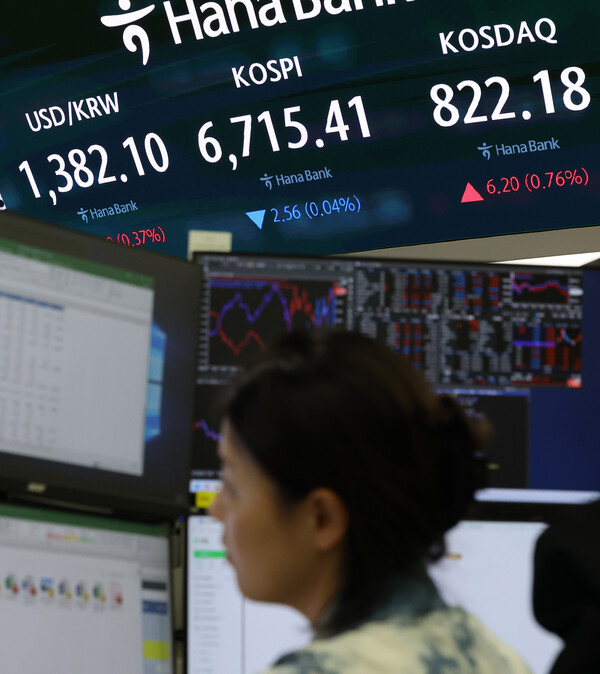
Overall stock market trading also slowed. Average daily turnover on the KOSPI from Sept. 1 to 16 was 21.0 trillion won, down 18.9 percent from 25.8 trillion won in August. That was down 43.1 percent from 36.9 trillion won in July.
Investor deposit funds, seen as sidelined cash in the stock market, stood at 99.6 trillion won as of Sept. 16, down about 5.75 trillion won from the previous day to fall below 100 trillion won. That was about 129.6 billion won less than 99.7 trillion won at the end of August.
Unsettled amounts in brokerage trading stood at 1.04 trillion won on Sept. 16, up 103.0 billion won, or 11.0 percent, from 939.4 billion won the previous day. It rose back above 1 trillion won after falling for two consecutive days on Sept. 14 and 15. It has recently fluctuated around 1 trillion won, including 1.15 trillion won on Sept. 7.
The actual value of forced liquidation tied to unsettled trading was about 17.4 billion won on Sept. 16, down from about 18.1 billion won the previous day. The Korea Financial Investment Association's ratio of forced liquidation to unsettled amounts was 1.8 percent, unchanged from the previous day.
Earlier, at the end of August, margin loans were concentrated in large semiconductor stocks. On Aug. 28, the combined margin loan balances for Samsung Electronics and SK Hynix totalled 10.4 trillion won, accounting for 31.2 percent of the total balance of 33.3 trillion won at the time. That was up 1.92 trillion won from 8.47 trillion won on Aug. 3.
If share prices fall further when the scale of leveraged investment is large, forced liquidation due to insufficient collateral could add to selling pressure. Still, a drop in leveraged ETF trading and a rise in margin loan balances alone cannot definitively show that investment funds have moved between the two markets.
The Financial Supervisory Service presented its direction for strengthening investor protection related to margin loans and unsettled trades at a public report meeting on financial consumer protection performance on Wednesday.
It is pushing steps including limiting unsettled trading by minors, requiring additional confirmation documents from older investors, providing advance simulations of the conditions for forced liquidation and the potential range of losses, and improving procedures for advance notice of forced liquidation.
Lee Se-hoon (이세훈), senior deputy governor of the watchdog, said at a briefing the same day that it is discussing details with related agencies, including the Financial Services Commission, and will announce improvement measures after final coordination of views. He explained, "We are approaching this in the direction of how to scale back investment using excessive leverage."
 Oh Sang-yup
yub@d-today.co.kr
Oh Sang-yup
yub@d-today.co.kr