
South Korea's Financial Supervisory Service identified rising complaints and disputes in the financial sector and short-term performance-driven sales practices as remaining challenges for consumer protection. It plans to strengthen an oversight framework focused on prevention rather than post-incident relief, including launching an artificial intelligence-based integrated portal for handling complaints and disputes in January next year.
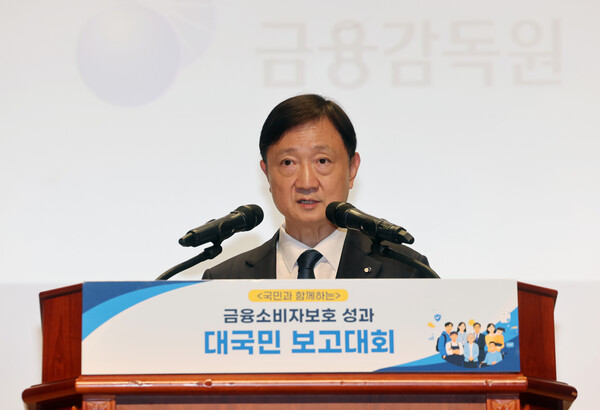
The FSS held a public report event on financial consumer protection performance on Sept. 17 at its headquarters in Yeouido, Seoul, with about 250 attendees including general financial consumers and representatives from the financial industry, related institutions and outside experts.
Lee Chan-jin (이찬진), governor of the FSS, said it has pursued consumer-oriented organisational restructuring, a shift to a preventive oversight framework, responses to financial crimes affecting livelihoods and stronger inclusive finance. He assessed that consumer protection has not yet taken firm root across financial companies' management and operations as complaints and disputes continue to rise and short-term performance-focused sales practices persist.
Lee said changes that consumers feel in the financial field are the true results, and that inconvenience and criticism from the field will be reflected in future policy.
Consumer-protection achievements over the past year released by the FSS on the day included cases in which issues identified during complaint and dispute processes were linked to institutional improvements.
From July last year to August this year, it reflected a total of 94 cases in institutional improvements and other measures. It also regularised the operation of its dispute mediation committee and expanded dedicated departments and staff. In disputes related to Tmon and Wemakeprice, it recognised consumers' right to withdraw after paying in instalments but being unable to use the service, and presented handling standards for 11,696 cases of the same type involving 13.22 billion won.
It also overhauled a step-by-step consumer-protection system spanning product design, sales and post-sale management. At the product design and manufacturing stage, it specified obligations for manufacturers and sellers. At the sales stage, it improved explanatory materials and subscription procedures focusing on key risks. It also strengthened post-sale notices of important information, including loss risks for high-risk products, changes in insurance payout criteria and conditions for card benefits.
It expanded the use of AI to respond to financial crimes. The FSS said it prevented 66.36 billion won in losses from October last year to July this year by using the ASAP AI platform for sharing and analysing voice phishing information. In the illegal private lending area, it is pushing measures including issuing confirmations that illegal loan contracts are invalid and supporting lawsuits to nullify them.
In digital finance, it launched the integrated control system FIRST in February and built the monitoring system ORBIT in April to analyse virtual asset order-book and execution information. Since last month, it has also been operating an AI-based market surveillance system targeting issues such as items suspected of unfair trading. An AI-based integrated portal for handling complaints and disputes to improve speed and quality is set to begin full operation in January 2027.
The FSS plans to continue meetings and on-site inspections to check whether preventive consumer-protection systems are actually working within financial companies. It will also strengthen digital supervisory capabilities through a "financial supervision AX strategy roadmap". It will pursue innovation in complaint and dispute handling using the AI complaints portal and bolster financial companies' own handling capabilities.
Some outside observers also pointed out that consumer protection should go beyond regulatory compliance and be linked to the competitiveness of financial companies' products and services.
Kwon-young Jang (장권영), head of Boston Consulting Group Korea, said consumer-centred management in South Korea's financial sector is still at an early stage and that the standard for judging consumer protection needs to shift from whether regulations are complied with to "Good Customer Outcome".
 Ji-young Lee
ljy@d-today.co.kr
Ji-young Lee
ljy@d-today.co.kr