
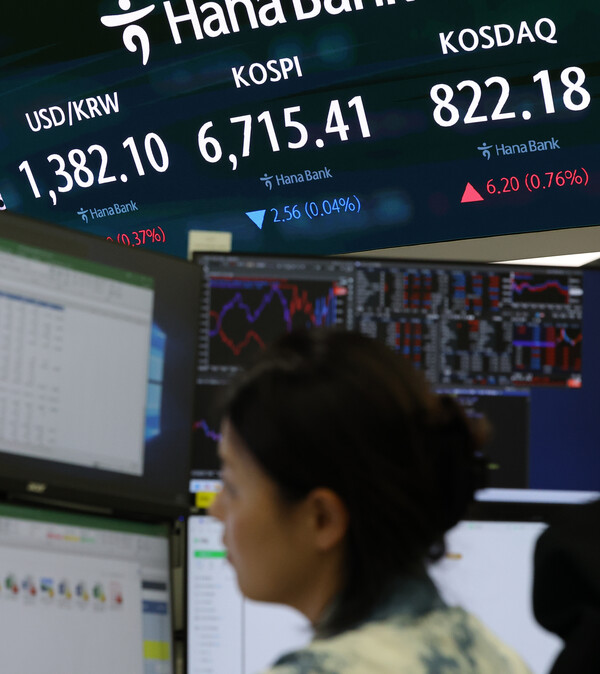
South Korea's KOSPI ended near flat on Wednesday despite a hawkish outcome from the U.S. Federal Open Market Committee (FOMC) and heavy net foreign selling. Chip heavyweights such as Samsung Electronics and SK Hynix fell, while some financial shares rose and helped support the lower end of the index.
The KOSPI closed down 2.56 points, or 0.04 percent, at 6,715.41. The index opened up 61.05 points, or 0.91 percent, at 6,779.02, but slipped below the 6,600 level in the afternoon as foreign selling intensified. It recovered most of its losses late in the session.
In the main board market, foreigners net sold 2.3 trillion won. Retail investors and institutions net bought 413.8 billion won and 158.6 billion won, respectively.
Among top market-cap stocks, semiconductor shares weakened. Samsung Electronics closed down 0.39 percent at 252,500 won, while SK Hynix fell 0.80 percent to 1,745,000 won.
SK Square fell 1.18 percent, Samsung Electro-Mechanics slid 3.69 percent, LG Energy Solution fell 0.54 percent and Samsung Biologics dropped 0.92 percent.
Hyundai Motor rose 0.28 percent, KB Financial Group gained 1.41 percent and Samsung C&T advanced 0.57 percent.
The Kosdaq ended lower. The junior index fell 6.20 points, or 0.76 percent, to 822.18.
In Seoul's foreign exchange market, the won was quoted at 1,381.70 per dollar at the close, down 4.20 won, or 0.30 percent, from the previous session.
Stocks appeared to be digesting the U.S. Federal Reserve's hawkish monetary policy stance. According to the market, at the September FOMC the Fed raised the median forecast for the policy rate at the end of this year to 4.1 percent from 3.8 percent and suggested the possibility of an additional rate hike within the year. It also presented a forecast of 4.1 percent at the end of 2027.
Fed Chair Kevin Warsh also left the door open to additional hikes, saying inflation has not improved enough.
Han Ji-young (한지영), an analyst at Kiwoom Securities, said the intensity of future tightening and the direction of earnings have a bigger impact on share prices than the rate hike itself. She said that after the September FOMC, it is necessary to focus more on the pace of gains in the U.S. 10-year yield than its absolute level.
She cited as a positive factor that current KOSPI operating profit forecasts for 2026 are holding up around 990 trillion won.
She also said the won-dollar exchange rate, which averaged in the 1,501 won range in the second quarter, fell to the 1,420 won range on average in the third quarter, which could weigh on earnings forecasts for exporters such as semiconductor and auto shares.
 Oh Sang-yup
yub@d-today.co.kr
Oh Sang-yup
yub@d-today.co.kr