
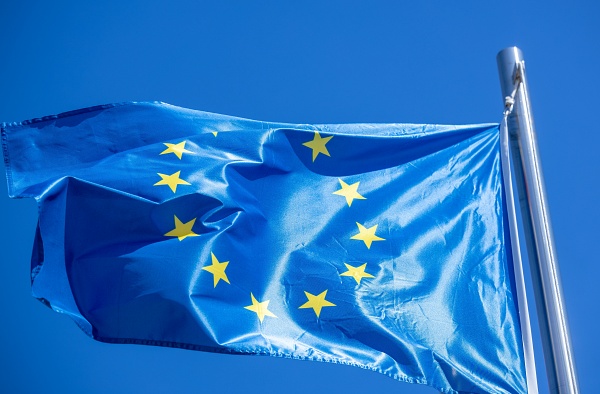
European Commission President Ursula von der Leyen is directly engaging in talks on slowing the pace of cutting-edge artificial intelligence development.
On Sept. 16 local time, blockchain media outlet Cryptopolitan reported that von der Leyen plans to invite major leading AI laboratories to Brussels to discuss how regulators can support efforts to manage the pace at the frontier.
In the annual State of the European Union address in Strasbourg, France, von der Leyen directly addressed the risks of increasingly powerful AI systems. "The risks that self-improving models could bring are becoming clearer and clearer," she said. It effectively formalised, at the European Union level, concerns that while technology is advancing rapidly, systems to control it effectively are not keeping up.
Her remarks also align with warnings raised within the AI industry. Dario Amodei (다리오 아모데이), chief executive of Anthropic, has urged slowing the development of more powerful models for safety reasons. Elon Musk's xAI and OpenAI's Sam Altman later backed such calls. Von der Leyen stressed that there is ample reason for regulators to take these concerns seriously, noting that even executives developing the technology think the shift to autoregressive systems should be slowed.
The AI industry is not united, however. Nvidia's Jensen Huang and Meta's Mark Zuckerberg have drawn a line against calls to manage the pace of development. Zuckerberg said each lab has both the responsibility and the incentive to move at the speed needed to train its models safely. He also argued that concerns over legal liability alone give developers sufficient motivation to prevent harmful systems from being released to the public.
A transatlantic gap in political views also emerged. Von der Leyen's position contrasts with U.S. President Donald Trump's, who has dismissed AI safety concerns. The European Union has already established a binding regulatory framework through the AI Act. The law allows regulators to halt the deployment of models judged to be unsafe and enables independent evaluation bodies to test advanced systems.
Von der Leyen called the AI Act essential and argued that Europe can play an important role in shaping a global approach to AI. She also said cross-border cooperation should be expanded for the testing and evaluation of cutting-edge AI models. Canada and Britain are expected to be included among those invited. The United States and China were not mentioned in the plan, even though the two countries are considered the twin pillars of the current AI competition.
The European Union's strategy was presented as putting more weight on securing economic value from AI rather than vying for the lead in an AI supremacy race. Von der Leyen named health, transport, agri-food, advanced manufacturing, and defence and space as priority areas. It is a plan for the European Union to design AI policy by combining its own regulatory authority with an industrial application strategy.
The speech also addressed children's use of social media. Von der Leyen proposed banning social media access for children under 13 and limiting the use of personal accounts by teenagers under 15. The plan also includes imposing an obligation on platforms to prove they offer services that are safe for minors.
The European Commission is set to release more details on the measures on Sept. 17. Attention is focused on whether Brussels will further specify a direction of pursuing AI safety regulation and an industrial application strategy at the same time.
 Jinju Hong
hongjj@d-today.co.kr
Jinju Hong
hongjj@d-today.co.kr