
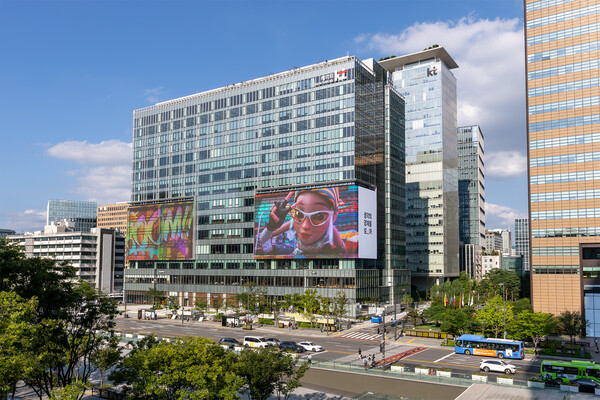
KT is expanding 5G specialised services for companies and public institutions. It is launching a leased "5G work-network egg" to lower the burden of buying terminals and pushing to apply "app slicing" to enterprise-only 5G to upgrade enterprise and public-sector work network environments.
KT held an online briefing on Sept. 17 to introduce a network portfolio with those plans. Over the mid to long term, it also plans to secure next-generation network technologies in line with the spread of AI and quantum computing, including AI-RAN, AI edge, post-quantum cryptography (PQC) and AI autonomous security.
KT launched the "5G work-network leased egg" to reduce upfront 부담 from buying terminals. The 5G work network is an enterprise wireless service that links a client company's internal network and KT's wireless network as a closed network based on dedicated lines. By connecting the dedicated egg device to a laptop, users can access the internal work network with security applied even outside the office.
The newly launched leased egg is offered by renting devices from KT and paying a monthly fee, instead of clients buying terminals directly. Clients can apply only for the quantity they need, reducing the burden of managing device inventory and condition themselves. KT provides integrated support across the full process, from service activation to device operation and fault response. The device fee is billed together with the 5G work-network line charge.
◆KT to push 'app slicing' within the year... Separate work and personal networks on a single smartphone
KT will apply app slicing, which splits the access network by application, within the year. App slicing is a technology that routes traffic through different network paths depending on the app used on a smartphone. Work apps are connected to the corporate network via enterprise-only 5G, while personal apps are separated to use the general internet network. Because the network is split, it is also possible to separate work-app traffic and personal-app traffic and bill them separately.
Myung Yu-jae (명유재), an executive director in charge of corporate wireless and IoT services at KT's Enterprise Service Division, said, "App slicing is a service that completely separates personal and work environments on a single smartphone." He added, "Work apps can be connected to the corporate network through enterprise-only 5G, while personal apps can be connected to the general internet network, separating the usage environment."
KT will combine enterprise-only 5G with its security solution and the government and public-sector dedicated gateway (GMG). KT built security tunnels across multiple layers, including through base stations and the GMG. In particular, it can apply a company's security policies even in a BYOD (Bring Your Own Device) environment where personal smartphones are used for work. It can logically separate work data and personal data without providing separate work-only devices.
The service applies URSP (UE Route Selection Policy), a 3GPP 5G standalone (SA) standard technology. It selects the network slice and data path each app will use based on app identification information and other factors. KT is working with Samsung Electronics and Google to develop and verify technology to implement app slicing on commercial smartphones.
KT has built 5G work networks for government ministries and local governments, starting with a 5G government network pilot project in 2020. It has recently expanded the service to a "5G work-network hub type" in which wide-area organisations and affiliated bodies share a single infrastructure. A case of building a work network linking the Gyeonggi provincial government and seven affiliated local governments won an excellence award, the Prime Minister's Award, at a "local government information and communications best practices presentation contest" held this month.
◆Securing AI-RAN and quantum security technology... Supporting next-generation enterprise networks
Along with expanding enterprise and public-sector 5G services, KT plans to secure network technologies needed for the coming era of AI and quantum computing. It is developing a hybrid approach that combines existing cryptographic systems with post-quantum cryptography. The method combines elliptic curve-based key exchange (ECDH) with PQC algorithms. It is also researching "USIM PQC" technology that stores key generation information in a hardware-isolated SIM card.
KT is also developing AI-RAN for ultra-low-latency and high-reliability networks needed for physical AI. AI-RAN combines AI with mobile networks to operate network resources efficiently and stably support real-time AI workloads and uplink traffic generated by robots and on-device AI. Through its "Hyper AI Network" project, KT plans to test key AI-RAN technologies at manufacturing sites, ports and telecommunications facilities, and verify physical AI application services such as AI painting robots and transport robots.
KT is also pursuing an AI edge strategy that uses about 3,500 KT telecommunications facilities nationwide as AI computing hubs. The plan is to link a central AI data centre with AI edge sites near industrial fields and process data closer to the field for services that require immediate decisions, such as robots and autonomous driving.
KT said, "Future networks will go beyond a simple data transmission infrastructure and become an intelligent infrastructure." It added, "KT will lead the way in opening the era of AI and quantum security."
 Jin-ho Lee (이진호)
jhlee26@d-today.co.kr
Jin-ho Lee (이진호)
jhlee26@d-today.co.kr