
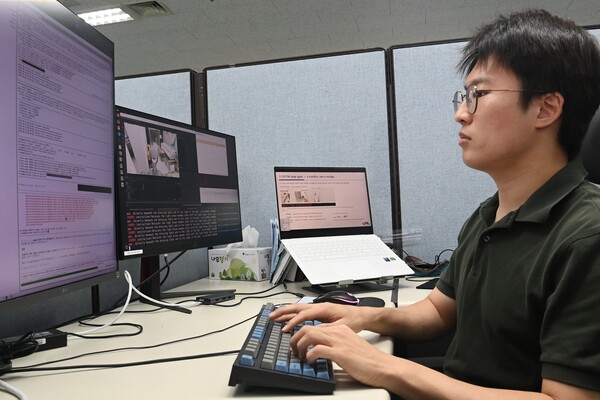
[Digital Today reporter Jin-ho Lee] South Korean researchers took first place in an international competition with robot AI technology that understands human speech and finds its own way to a destination.
The Electronics and Telecommunications Research Institute (ETRI) said on Sept. 16 it formed a joint team with the Korea Advanced Institute of Science and Technology (KAIST) and won first place among 112 teams in the VLNVerse challenge at the 'ECCV 2026' computer vision conference held in Malmo, Sweden.
Vision-language navigation (VLN) is a technology that lets a robot understand a person's natural-language commands, examine its surroundings with a camera and move to a destination on its own. Even without building a precise map or manually entering a route, the robot finds its way by understanding the surrounding space and the command together.
ETRI's Field Robotics Research Section and a team led by KAIST professor Hyun Myung (명현) participated as the 'URL-FRRS' joint team and recorded an average success rate of 90.7 percent in an evaluation combining two tasks, including target search and detailed driving. It had the same success rate as the second-place team but took the top spot under contest rules because it submitted earlier.
The researchers focused on solving a problem in which a robot incorrectly judges that it has arrived when it is not at the destination. They trained a vision-language model (VLM) with about 8 billion parameters for robot navigation and improved performance in determining whether it had arrived at the destination.
They also developed 'CoRe-VLN' technology in which the robot, if it stops incorrectly, checks again whether it has arrived and re-searches for the destination on its own. The approach has the robot capture surrounding video after stopping, and multimodal AI checks the location, target and distance information and searches again for a new route if it determines it is not at the destination.
The research used 32 Nvidia H200 GPUs supported through the Ministry of Science and ICT and the National IT Industry Promotion Agency (NIPA) 'advanced GPU utilization support program.'
ETRI plans to apply the technology to a navigation robot for the visually impaired called 'Guide Dog' and to on-device robot mobility intelligence based on domestically made AI chips. It plans to 추진 the development of technology by 2029 to run VLMs on domestically made neural processing units (NPUs) so that autonomous agents such as humanoids can move around manufacturing and logistics sites without precise maps.
 Jin-ho Lee
jhlee26@d-today.co.kr
Jin-ho Lee
jhlee26@d-today.co.kr