
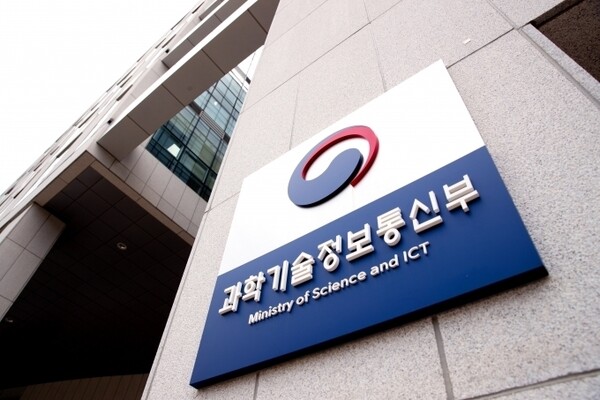
South Korea's Ministry of Science and ICT will restructure functions at its affiliated public agencies, including integrating the Korea Data Agency (K-DATA) as an affiliated body under the National Information Society Agency (NIA). It will also link functions between the National Research Foundation of Korea and the Korea Technology Commercialization Promotion Agency. The ministry is also pushing to establish a new National Science Museum Foundation to integrate 4 regional national science museums.
The ministry said on Tuesday it would pursue functional reform to consolidate similar and overlapping functions among public agencies under its oversight and strengthen linkages between institutions, in line with the government's plan to 추진 a public agencies functional reform announced on Sept. 3. The restructuring focuses on strengthening links between data policy and research and development (R&D) and commercialisation, and integrating dispersed facility management and science museum operation functions.
K-DATA to become an affiliated body under NIA, linking data policy and industry support
The ministry will first integrate K-DATA as an affiliated body under NIA. It will combine NIA's data policy support functions with K-DATA's accumulated capabilities in promoting the data industry and supporting data use and distribution, to boost the execution of data policy as AI spreads. The ministry's plan is to reflect demand from industrial sites more quickly in policy and to raise the professionalism of support for data-related projects.
It will also integrate the National Research Foundation of Korea and the Korea Technology Commercialization Promotion Agency. The commercialisation agency will be placed as an affiliated body under the foundation to strengthen linkages from basic and original R&D to technology transfer and commercialisation. The ministry will also pursue a plan to use the commercialisation agency's industry network to reflect public and private technology demand at the research project planning stage.
The ministry will also restructure functions of Research and Development Special Zone FNS, a subsidiary of the Innopolis Foundation. Facility management and cleaning will be transferred to the Science and Technology Facilities Management Agency, while security and guidance work will be transferred to the Science and Technology Security Management Agency. The ministry expects this will reduce the Innopolis Foundation's burden of managing subsidiaries and allow it to focus on its core work, including region-led R&D and support for deep-tech startups.
Integrate 4 regional national science museums, create new National Science Museum Foundation
Four regional science museums operated as independent entities, including the National Daegu Science Museum, National Gwangju Science Museum, National Busan Science Museum and National Gangwon Specialized Science Museum, will be integrated into a single entity.
To this end, the ministry will push to establish a new foundation tentatively named the National Science Museum Foundation. The move aims to reduce duplicative investment arising as regional science museums each develop exhibition and education content, and to enable joint use of exhibition content and collections.
The ministry will also pursue organisational efficiency measures for small institutions. The Separate Post Office Pension Management Agency, with a staff of 12, will be integrated into the Post Office Facilities Management Agency, which will set up a Separate Post Office Pension Management Center internally. The aim is to maintain expertise in pension management while consolidating common organisations such as personnel and accounting.
The ministry will begin follow-up work, including enacting and amending relevant laws and regulations needed for the institutional integrations. During the integration process, it plans to gather opinions from relevant ministries, local governments and labour unions, based on the principles of employment succession and maintaining existing treatment for employees.
 Jin-ho Lee
jhlee26@d-today.co.kr
Jin-ho Lee
jhlee26@d-today.co.kr