
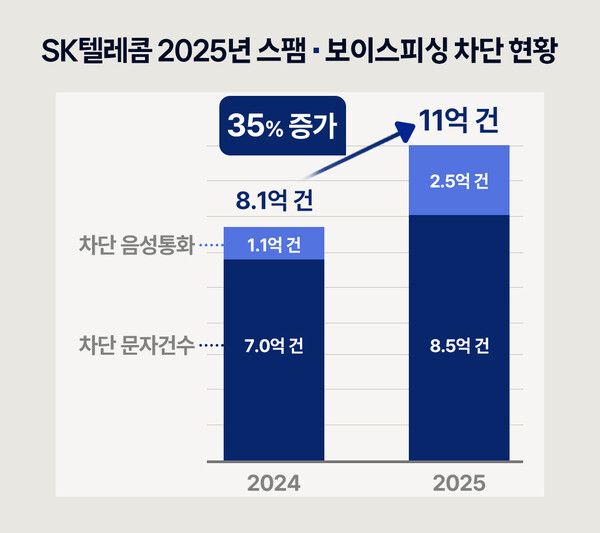
SK Telecom said on Jan. 13 it proactively blocked about 1.1 billion attempted telecom fraud cases in 2025, including voice spam, voice phishing calls and text messages.
That was up 35 percent from a year earlier. SKT said it reflected the company’s active adoption and systematic operation of AI technology in spam and phishing response work.
Last year, SKT introduced an AI model based on call-pattern analysis that preemptively detects and blocks suspected voice phishing phone numbers that have not been reported to relevant authorities. It said it blocked 250 million voice spam and voice phishing calls, up 119 percent from a year earlier, and 850 million text messages, up 22 percent.
It also applied its self-developed AI-based financial fraud detection security technology, ScamVanguard, to the bait-message alert service in SKT PASS spam filtering and to the AI safety blocking function in A.Dot Phone.
It detects voice phishing and spam calls and texts, including impersonation of financial institutions and acquaintances, and provides warning alerts to users. A.Dot Phone also supports an AI voice phishing detection function that analyses risk signs in real time during calls and immediately notifies users with pop-ups and alert tones.
This year, SKT will expand the application of AI technology across the full process of blocking spam and phishing. To preemptively respond to increasingly sophisticated phishing threats, it will automatically detect, collect and analyse malicious apps using AI. It plans to build a one-stop response system that runs from threat blocking to prevention of damage, raise the safety of telecom services and further strengthen customer protection.
Son Young-kyu, head of security governance at SKT, said, "We will continue to strengthen our technical and institutional response capabilities, and actively take the lead in eradicating voice phishing and illegal spam in cooperation with the government and relevant agencies."
 Jinho Lee
jhlee26@d-today.co.kr
Jinho Lee
jhlee26@d-today.co.kr