
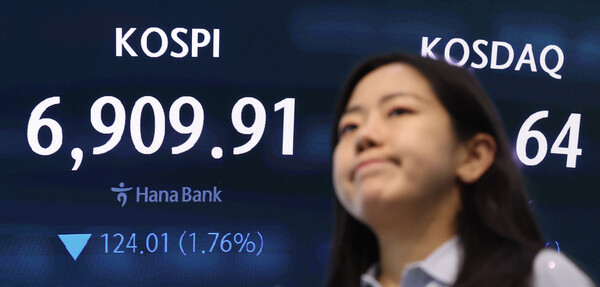
South Korean stocks are expected to search for direction this week ahead of the U.S. Federal Open Market Committee (FOMC) meeting, caught between interest rates and corporate earnings. Semiconductor and artificial intelligence (AI)-related results remain solid, but the KOSPI is likely to stay range-bound as the burden of U.S. long-term yields and international oil prices persists.
South Korean stocks rebounded last week. The Korea Exchange said the KOSPI and the Kosdaq rose 5.2 percent and 2.9 percent, respectively. Existing leading sectors such as information technology (IT) hardware and semiconductors strengthened, and buying spread to some financial and capital goods sectors.
Still, the market says it is too early to view the recent rise as a full-fledged trend reversal. It is because the discount rate applied to stock prices, or the burden of interest rates, is capping gains more than corporate profit forecasts themselves.
U.S. long-term yields remain high. A rise in international oil prices, geopolitical tensions and U.S. fiscal burdens have combined to keep 10-year Treasury yields elevated. When rates rise, the discount rate used to convert future corporate profits into present value increases, weighing on growth stock valuations.
The most important event this week is the FOMC on Sept. 17 local time. The market is expected to focus not only on the policy rate decision but also on economic projections that include the future rate path and the Federal Reserve's message.
The industry says it will be difficult for tightening concerns to be fully resolved even if rates are kept on hold. If the possibility of further rate hikes remains, U.S. long-term yields may stay high and limit the upside momentum of South Korean stocks.
Some analysts also say the market does not necessarily suffer another sharp drop even if an actual rate hike is implemented. In cases where market rates fell after passing a peak and stock markets rebounded, the Fed's first policy rate hike in the past was followed by a period of rate holds.
In the end, signals on how long additional tightening will continue matter more than the rate decision itself at this FOMC. If uncertainty over the rate path eases, some of the price burden on stocks pressed down by high discount rates could also be relieved.
Corporate earnings still underpin the downside in South Korean stocks. Earnings forecasts for semiconductor and AI hardware companies have recently remained solid. Expectations for profits in IT sectors, including semiconductors, are being sustained as investment in AI infrastructure continues.
In particular, the market says recent moves reflect valuation adjustments driven by rising rates rather than a deterioration in corporate earnings. If earnings forecasts hold, share prices may recover faster from the point when the rate burden eases.
Shareholder returns are also supporting the downside in the index. Large-scale share buybacks and cancellations led by Samsung Electronics and SK Hynix are continuing, producing a supply-and-demand effect that absorbs foreign selling.
Still, share buybacks alone are unlikely to drive a sustained market uptrend. The market says the KOSPI is likely to break out of its range only when a shift to net foreign buying and a recovery in trading value appear together.
Sector differentiation is also expected to continue. Volatility in the index has fallen recently, but gaps in sector returns have widened. When the index is trapped in a certain range, funds tend to concentrate in sectors with strong earnings and profit forecasts rather than lifting the broader market together.
Semiconductors and IT hardware are still seen as core leading sectors based on earnings momentum. Financial sectors such as banks and insurers, where profit forecasts improve in a high-rate environment, as well as energy and some capital goods, could also be relatively favorable, the market says.
By contrast, growth stocks, whose price gains were mainly based on expectations of falling rates rather than earnings improvements, may move more sensitively to rate changes. The Kosdaq also appears to require a focus on stocks with confirmed earnings rather than the overall index until the rate burden eases.
In the short term, analysts are putting more weight on repeated ups and downs than on a V-shaped rebound. Lows are rising after a sharp drop, but there is a lack of new drivers to push the index sharply higher, and a range-bound market with narrowing highs and lows could continue for the time being, they say.
Ultimately, the key for South Korean stocks this week is how much uncertainty over high rates can be resolved through the FOMC. If the rate burden eases, buying could flow back into sectors with improving earnings, led by semiconductors, and the KOSPI could try to break above the 7,000 level.
If U.S. long-term yields and international oil prices rise further, the range-bound market could last longer.
Donggil Noh (노동길), a research fellow at Shinhan Securities, said, "The problem is the discount rate itself rather than earnings," and added, "After volatility stabilizes completely, the market's center is expected to shift to fundamentals."
Jongmin Kim (김종민), head research fellow at Samsung Securities, said, "Unlike the complex macro environment, the micro environment is very clear," and projected that AI momentum and earnings at South Korean semiconductor companies will support the downside in the market.
Jaeman Lee (이재만), a researcher at Hana Securities, said short-term volatility may differ depending on whether rates are raised, but added, "Even if a rate hike is implemented, if a hold stance is confirmed, the market can turn back into a bull market."
 Sangyeop Oh
yub@d-today.co.kr
Sangyeop Oh
yub@d-today.co.kr