
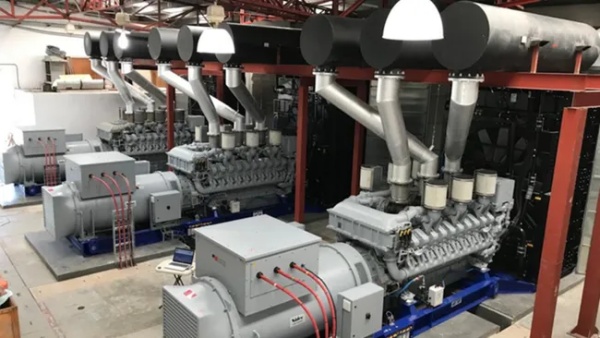
The U.S. Navy has approved Rolls-Royce marine engines for uncrewed surface vessels that can operate for up to 30 days without crew.
TechRadar, an IT news outlet, reported on Sept. 10 that the certification covers Rolls-Royce MTU Series 4000 and Series 2000 engines.
The approval comes as the Navy expands operations of uncrewed surface vessels. The Navy is increasing their use for missions that should not expose crew to risk and is making the securing of a propulsion system capable of long-duration autonomous operation a key condition.
The Series 4000 underwent two 720-hour endurance evaluations before approval. It produces up to 4,300 kilowatts for propulsion and can supply up to 3,000 kilowatts as an onboard power-generation system. The Series 2000 was approved after passing parts inspections and operational tests and has propulsion output of up to 1,939 kilowatts.
The two engine families can now be installed on U.S. Navy uncrewed vessels for long-duration missions. The key point is that they will be applied to vessels designed to operate for long periods without routine maintenance or repairs, even with no one on board.
The certification reflects requirements under the U.S. National Defense Authorization Act. It verified suitability in line with a system that applies certain conditions to equipment used in autonomous military platforms.
There are already deployments. The U.S. Navy has begun deploying uncrewed boats including Sea Hunter, fitted with two MTU 12V 2000 engines supplied by Rolls-Royce. The new certification can be seen as a move to broaden connectivity with existing uncrewed-vessel capabilities.
Scott Hanson (스콧 핸슨), vice president for North America government sales at Rolls-Royce Power Systems, highlighted reliability, saying, "For decades, MTU engines have provided reliable, mission-ready power to maritime crews." Rolls-Royce sees durability and sustained operating capability as what is required in the new autonomous mission environment.
For the U.S. Navy, the approval expands options for operating uncrewed surface vessels that can remain at sea for long periods without crew. Such vessels can carry out long maritime missions while reducing the burden of living space, support systems and immediate safety measures required for crewed ships. Rolls-Royce also said the certification provides additional options for the Navy as it seeks to integrate uncrewed vessels into overall fleet planning.
The certification does not, however, guarantee 30 consecutive days of operation for all uncrewed vessels. Actual operating duration can vary depending on vessel design, speed, weather, payload, fuel capacity, mission requirements and maintenance needs. What the U.S. Navy has secured immediately is not identical performance under all conditions, but a certified propulsion option premised on long-duration uncrewed operations.
Engine reliability also remains a key variable in expanding uncrewed vessels. If a failure occurs in waters far from support facilities, mission execution itself could be blocked. Rolls-Royce already supplies propulsion equipment for unmanned aircraft such as the MQ-4C Triton, MQ-25A Stingray and the U.S. Air Force's RQ-4 Global Hawk. The approval is continuing as a case that expands the U.S. military's existing business relationships into the maritime autonomous-operations domain.
 Jinju Hong
hongjj@d-today.co.kr
Jinju Hong
hongjj@d-today.co.kr