
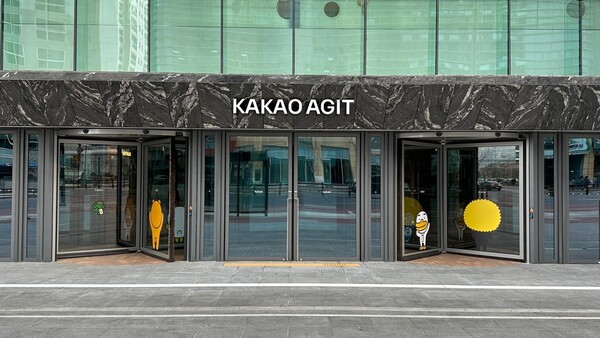
Kakao will directly explain its planned corporate spin-off in a bid to ease concerns among retail shareholders. The company’s share price has weakened since the announcement, and opposition has emerged among individual shareholders and the labour union. With an extraordinary shareholders meeting set for December, the move is seen as an effort to persuade shareholders of the need for the split and its expected effects.
A Kakao filing on Thursday showed the company will hold an online meeting for retail shareholders at 4 p.m. on Sept. 16. It will explain the outline of the spin-off, the background to the plan and expected effects, and hold a question-and-answer session. Kakao said the purpose is to explain key matters related to a governance restructuring and improve investor understanding.
This is Kakao’s first separate briefing for retail shareholders on the spin-off since it announced the plan on Aug. 21.
After the announcement, the share price has weakened; Kakao moves to directly persuade retail shareholders.
Kakao plans to split into a new entity, KakaoAI, in charge of KakaoTalk and AI-based platform businesses, and a surviving entity, KakaoX, tasked with investing in key affiliates in tech-finance, content and mobility, and discovering new growth businesses. The split ratio, based on net asset book value, is 36.49 percent for KakaoAI and 63.51 percent for KakaoX.
The company aims to separate its business structure to build decision-making and capital allocation systems suited to each business and to have the market assess the value of each business more clearly. Existing shareholders will receive shares in both KakaoAI and KakaoX in line with the split ratio.
The stock has remained weak since the spin-off announcement. Kakao shares were 38,700 won on Aug. 20, the day before the board resolution on the spin-off, and fell 7.49 percent to 35,800 won on Aug. 21, the day of the announcement. The shares have not recovered to their prior level and ended trading on Sept. 10 at 34,900 won, about 9.8 percent lower than the day before the resolution.
Individual shareholders are also calling for a more concrete presentation of the benefits of the split. Minority shareholder platform Act said the company needs to explain whether independent management by business and faster decision-making are goals that are difficult to achieve through restructuring alone. It also said Kakao should present the economic benefits for existing shareholders after the split, the path to raising the value of the two companies, and measures for shareholder returns and shareholder protection.
In a pre-vote disclosed by Act on Sept. 7, 99.97 percent of participating shares supported an agenda item to launch a campaign responding to the spin-off, and 100 percent supported an item to request a detailed analysis by the Act research unit. As of Sept. 10, the stake gathered in the campaign was about 0.31 percent, meaning its share of total voting rights remains limited.
Kakao’s sensitivity to individual shareholder sentiment stems from its ownership structure and the voting requirements at shareholder meetings.
Kakao currently has about 1.6 million minority shareholders, who hold about 60 percent of total issued shares. The spin-off agenda must pass a special resolution at an extraordinary shareholders meeting on Dec. 17. A special resolution requires approval by at least two-thirds of voting rights of shareholders present, and at the same time the number of shares voting in favour must be at least one-third of total issued shares.
Not all minority shareholders oppose the spin-off, but if opposition among individual shareholders expands, the burden on the company could grow. With passage difficult to guarantee on the basis of the stake held by the largest shareholder and related parties alone, how institutional investors and individual shareholders vote will be important.
Kakao’s labour union has also said it opposes the spin-off and has signalled it will seek to persuade major shareholders and minority shareholders. Individual shareholders mainly take issue with shareholder value and the economic benefits of the split, while the union focuses on job security and management reform. Both sides share concerns over whether the need for the split and follow-through plans have been sufficiently presented based on what has been disclosed so far.
The key to the Sept. 16 meeting is expected to be how specifically Kakao answers why it needs to split into separate corporations rather than carry out a restructuring, rather than simply re-explaining the structure of the spin-off. Under the spin-off, existing shareholders receive shares in both KakaoAI and KakaoX, but the method itself does not guarantee a rise in corporate value or shareholder value.
Ultimately, what Kakao must persuade shareholders on is the outcome rather than the form of the split. It needs to present more concretely how the value of KakaoAI and KakaoX will rise, what economic benefits existing shareholders can gain, and how it will put in place shareholder return and protection mechanisms. If it merely repeats the previously disclosed background and expected effects, there may be limits to its ability to resolve shareholder doubts.
Kakao plans to complete the split on Jan. 1, 2027 after securing approval for the agenda at the extraordinary shareholders meeting in December. It also plans to pursue a relisting of KakaoAI and a change listing of KakaoX on Jan. 27 of the same month.
The Sept. 16 meeting is expected to be the first turning point in persuading shareholders over the planned spin-off.
 Lee Ho-jung
lhj@d-today.co.kr
Lee Ho-jung
lhj@d-today.co.kr