
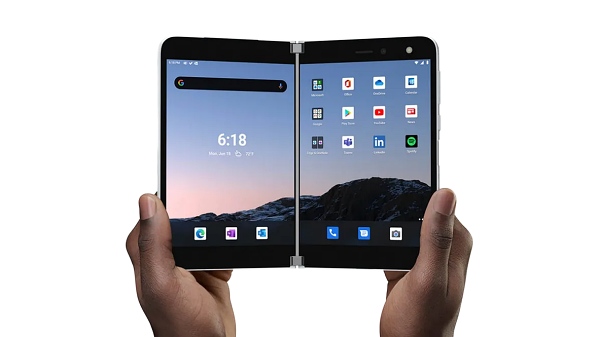
Apple’s first foldable iPhone, the iPhone Duo, unveiled on Sept. 9 local time, is the second case of a foldable smartphone using the name “Duo”. The first was Microsoft’s Surface Duo, which effectively exited the market two years after its 2020 launch.
■ Folding screen vs split screen
Surface Duo was a product that gave up on a “folding screen” from the start. After Samsung’s Galaxy Fold, released the previous year, struggled with hinge defects and controversy over screen damage, Microsoft chose to connect two 5.6-inch OLED panels with a hinge instead of a flexible display. A clear gap between the screens remained.
By contrast, iPhone Duo adopted a true folding screen, highlighting a custom nanotexture display material designed to minimise creases. As foldable display technology has matured over six years, Apple is in effect taking on head-on the “real foldable” that Surface Duo avoided.
More than hardware, what held Surface Duo back was software. At launch, it drew criticism at once for unstable completeness, a disappointing camera and lagging specifications. Microsoft released an improved version, the Duo 2, the following year, but failed to turn things around and ultimately moved toward discontinuation.
■ What brought down Surface Duo was software in the end
Apple appears to be trying to avoid the same mistake by moving unusually early to support developers. On the day of the unveiling, it opened a developer-only page and broke down app compatibility modes into three stages: iOS26, iOS27.0 and iOS27.1. It said full compatibility will be supported starting with iOS27.1, to be distributed together in October. It also flagged Group Lab on the 16th to 17th, Q&A sessions on Photos, Camera, SwiftUI and UIKit on the 23rd, and workshops worldwide later this month, giving third-party developers time to adjust apps before launch, another contrast with the Surface Duo.
In the end, what separates the two “Duo” devices is timing. Surface Duo collapsed as the foldable form factor itself was unfamiliar, with hardware compromises and software shortcomings compounding. iPhone Duo is entering a market where foldables are already proven, while seeking to have both display completeness and app ecosystem readiness. Whether the name “Duo” this time remains as a success case rather than a failed product is expected to be determined after the actual launch in October.
 Hyunwoo Choo
cookinpapa@d-today.co.kr
Hyunwoo Choo
cookinpapa@d-today.co.kr