
Anthropic published a webpage setting out economic scenarios that assume how artificial intelligence (AI) could affect U.S. employment and gross domestic product (GDP) through 2030. It projected that AI could raise productivity and expand the economy while also having a negative effect on knowledge workers’ jobs and wages.
On Sept. 10 (local time), Anthropic and Gigazine said Anthropic’s economics research team built a model analyzing how AI could affect U.S. jobs, economic growth and the unemployment rate, and presented three economic scenarios based on it. Anthropic explained that AI can support or automate existing tasks rather than eliminating jobs across the board, while also creating new tasks.
Anthropic cited nursing work as an example. It said AI could automate tasks such as recording patient conditions or ordering ward supplies, while new tasks could emerge in which nurses review AI’s patient triage results or treatment plans. It said AI adoption may proceed by changing the weight and content of tasks that make up existing roles rather than eliminating occupations themselves.
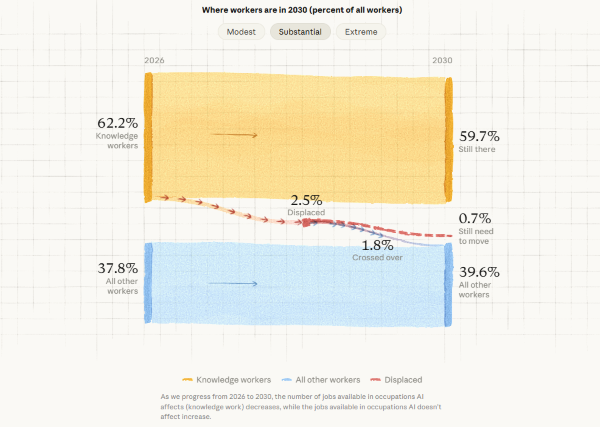
The economic growth outlook is divided into a mild scenario, a meaningful scenario and a radical scenario. The mild scenario is one in which AI has an economic impact similar to the internet. The meaningful scenario assumes that by 2030 AI advances enough to perform half of all knowledge work and the economic growth rate rises to about twice the usual level. The radical scenario assumes AI becomes more productive than humans in most knowledge work and virtually no new tasks for humans are created in knowledge-work fields.
U.S. GDP in 2030 was presented as $34.1 trillion, 1.6 percent higher than in a case without AI, under the mild scenario; $36.3 trillion, 8.3 percent higher, under the meaningful scenario; and $44.4 trillion, 32.4 percent higher, under the radical scenario. Under the radical scenario, it projected annual GDP growth could reach 15 percent as AI spreads, and the economy could double every 4.5 years.
Even if the economy expands, that does not mean employment conditions improve. Under the meaningful and radical scenarios, more workers may have to move to new occupations as automation and job replacement increase in knowledge-work fields. It said changing occupations entirely requires learning new skills and takes time to find new jobs, and unemployment could rise during the transition process. Under the radical scenario, it also presented the possibility that workers affected by AI’s rapid spread could face long-term unemployment.
Under the radical scenario in particular, it forecast the share of knowledge workers in the overall workforce would fall to 48.7 percent in 2030 from 62.2 percent in 2026. It explained that as AI replaces a significant portion of knowledge work, jobs in those occupations could decline, while jobs in other occupations less affected by AI could increase.
Wage gains were also expected to vary by occupation. Anthropic said average wages rise in all three scenarios, but the increases would be concentrated in occupations other than knowledge work. Under the meaningful scenario, it projected knowledge workers’ wages would effectively stagnate, and under the radical scenario they could fall by more than 10 percent by 2030. It also explained that demand derived from knowledge-work fields where AI boosts productivity could lift wages in other occupations such as construction.
Even if AI expands the economy, the gains may not accrue equally to workers. Anthropic projected that under the radical scenario, labor’s share of GDP would fall to 45.2 percent and capital’s share would rise to 54.8 percent. It said that as the benefits of rapid economic growth flow more to capital owners, labor income may barely increase through 2030.
Anthropic stressed that the scenarios are not a definitive forecast of the future but a model to examine economic outcomes under various conditions. It said actual results could differ depending on AI capabilities, the pace of adoption by companies and workers, and how the technology’s economic gains are distributed. It added that policy responses, business cycles, changes in aggregate demand from data center investment and highly advanced robots are not included in the current model, and it plans to keep updating the scenarios as new evidence becomes available.
 Seung-a Yoo
ysah@d-today.co.kr
Seung-a Yoo
ysah@d-today.co.kr