
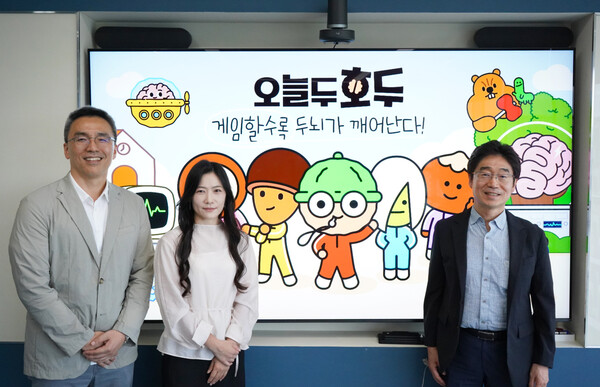
Cognitive-function startup Beluga plans to expand its business into digital therapeutics based on its brain-training game 'Today's Walnut'. The company aims to analyse behaviour data accumulated as users play to gauge cognitive status, and over the longer term develop a digital therapeutic device for mild cognitive impairment.
Beluga CEO Jong-yoon Kim (김종윤) said in an interview on Sept. 9 at Kakao Games' headquarters in Pangyo, Gyeonggi province, that "'Today's Walnut' serves as a basecamp to secure the data needed to develop AI models and to apply the technology we develop first."
'Today's Walnut' is a casual brain-training game that Beluga jointly researched with Kakao Games and released on Aug. 24. It is designed to train five areas through multiple mini-games: memory, attention, executive function, language ability and visuospatial ability. Separate from training content, it also offers a measurement function that lets users check their cognitive status.
Beluga started out with the goal of developing a digital therapeutic device for mild cognitive impairment. It later decided it was necessary to help detect early risks of cognitive decline before treatment and first developed the mobile cognitive assessment service 'Brain OK'. It then broadened into services that allow continuous cognitive training and introduced 'Today's Walnut'.
Kim, who worked on game platform and technology development at Naver, Wemade and Kakao Games, said he wanted to apply the fun of games to solving social problems.
"Games have more technical challenges and are more progressive than other industries, but there are also views that see them negatively," Kim said. "I became interested in functional games because I thought it would be meaningful if games could provide value beyond fun."
◆ Turning gameplay into data... AI research into cognitive inference
Beluga is focusing not only on final game scores but also on behaviour data generated as users solve problems. Conventional hospital tests run for a set time and mainly present final results. In contrast, digital games can accumulate data on performance processes that vary by user, such as solving speed and response patterns, it said.
Kyung-bok Min (민경복), a professor in the Department of Preventive Medicine at Seoul National University College of Medicine, said hospital tests are accurate and have long been validated but mainly look at final results. He said measuring diverse behaviours that differ by person during the testing process can yield thousands of variables, and AI and big data analysis may make it possible to find information that is more important than final values.
Beluga is jointly researching core AI models for the cognitive profiling platform 'Mind Play' with Kakao Games. The goal is to develop technology that estimates users' cognitive status based on data secured from games and provides services tailored to individual characteristics.
Beluga principal researcher Hye-yeon Joo (주혜연) said the company is ultimately considering a way to infer cognitive status based on game data that was difficult to obtain through existing tests, without going through separate cognitive measurement tools.
The mini-games in 'Today's Walnut' were divided into five areas by analysing the cognitive activities each game requires. Joo is responsible for breaking down the cognitive functions needed for each game in detail and analysing what changes appear depending on how long and how continuously users use certain content.
The reason for choosing the game format is sustainability. Cognitive training is difficult to confirm effects over the short term, so consistent repetition is important, but existing training programmes often lack fun, making it hard for users to keep using them.
Min said there were existing cognitive training programmes directly made by professors and researchers, but many users tried them once and stopped because they felt like test questions. He said creating a service that people can keep using requires game development experience and technical completeness.
Another mechanism supporting continued use is a low barrier to entry. 'Today's Walnut' is designed so users can use about 15 minutes a day of basic training without separate payments or mandatory ad viewing. It separately runs paid products that allow longer gameplay or the use of hints.
Kim said it might be a negative from a business standpoint, but it made sense given the reason the company started, to realise and contribute social value. As greater user participation leads to a larger stockpile of cognitive data, this approach also aligns with Beluga's strategy for securing data.
◆ Preparing senior and overseas versions... digital therapeutic device development in 2028
Beluga is also preparing a separate version for older users. It built the current service with users up to their 60s in mind, but judged that there are aspects that are somewhat inconvenient for users aged 70 and above. It plans to introduce a senior version that adjusts screen layout, controls and game difficulty, and to secure related data.
It is also pursuing overseas expansion. It plans to release an English version in the first half of next year and then gradually expand supported languages. As language ability is one of the major cognitive areas, it will not simply translate existing content but will newly produce content suited to English users.
Over the longer term, it plans to develop a digital therapeutic device for mild cognitive impairment. Beluga plans to secure data through operating the senior version and refine the service before starting development of a digital therapeutic device in 2028.
However, the cognitive improvement or dementia prevention effects of the currently released 'Today's Walnut' have not been medically verified. Beluga is also distinguishing between the validity of the measurement function and the training effect.
Min said "'Today's Walnut' has a high level of technical completeness as software, but it has not yet been medically verified." He said it is currently at a stage of securing data to improve public health and medical completeness and preparing for large-scale research.
The measurement technology applied to the existing 'Brain OK' was published as a paper in the international academic journal Diagnostics after research comparing correlations between in-person cognitive tests used in hospitals and mobile measurement results. Min said the research was not a formal clinical trial and that additional verification through an independent external institution is needed.
Beluga also plans to separately verify the training effect of 'Today's Walnut'. It enabled users to conduct cognitive measurements before and after using the game for a certain period to check for changes. Based on accumulated data, it plans to pursue effect verification research and paper publication from next year.
Kim said it was not at a stage to conclude there is an effect because usefulness has not yet been proven through papers or clinical trials. He added that because he is confident in the training effect, the company included the cognitive measurement function so users can directly check changes before and after.
 Hojeong Lee
lhj@d-today.co.kr
Hojeong Lee
lhj@d-today.co.kr