
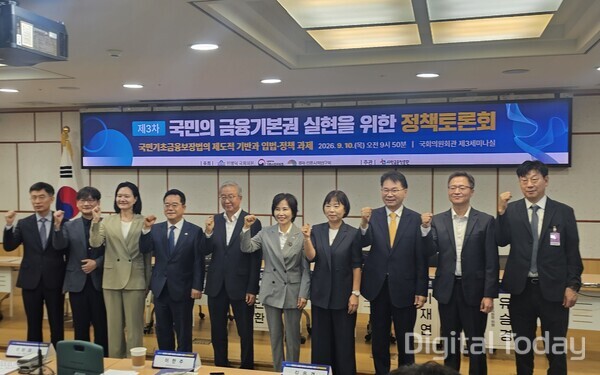
Discussions are gaining pace on enacting a "Basic Financial Security Act" to guarantee financial access for low-income and low-credit groups, covering everything from counselling and debt adjustment to insurance, loans and savings. The proposal calls for expanding policy-based inclusive finance beyond simple funding to a financial security system that links crisis recovery, economic self-reliance and asset building.
A policy forum titled "Policy forum to realise the public's basic financial rights" was held on Thursday morning in Seminar Room 3 of the National Assembly Members' Office Building, hosted by Democratic Party lawmaker Min Byung-deok (민병덕) and organised by the Korea Inclusive Finance Agency. The forum discussed the institutional foundation of the Basic Financial Security Act and legislative and policy tasks, as well as the performance of policy-based inclusive finance, overseas systems and the economic and social effects of introducing basic financial rights.
In opening remarks, Min said low-income and low-credit groups are being left without access to even basic financial services, stressing the need to enact the law.
Min referred to long-delinquent debt claims totalling 50 trillion to 60 trillion won in principal and said they have become lifelong shackles for debtors who have already lost their ability to repay. He said it has become a state task that the government must take responsibility for resolving, not an individual misfortune.
He explained that the Basic Financial Security Act is being discussed in a direction that would codify five basic financial rights based on Articles 10, 11 and 34 of the Constitution: the right of access to finance, the right to survival, the right to restart, the right to self-reliance and the right to build assets. A key element is building a one-stop system where people can receive needed support in one place, from counselling and debt adjustment to insurance, loans and savings.
Kang Nam-hoon (강남훈), vice chairman of the Basic Society Committee and an emeritus professor of economics at Hanshin University, also stressed the need to broaden the scope of policy-based inclusive finance. Kang said it needs to develop into a comprehensive financial security system linking counselling and prevention, recovery from crisis, economic self-reliance and asset building, rather than viewing it simply as funding.
Kim Eun-kyung (김은경), head of the Korea Inclusive Finance Agency, said detailed institutional design to realise basic financial rights is under way. The agency, after launching a research group on basic financial rights, is preparing details centred on four basic financial services: basic counselling and debt adjustment, basic insurance, basic loans and basic savings.
Kim said if inclusive finance is a policy direction aimed at leaving no one excluded, basic financial rights are the legal and institutional foundation that establishes that direction as the public's rights and a public responsibility. She said the forum is a step toward linking this to an executable system.
◆Support must extend beyond loans to self-reliance
Experts said existing policy-based inclusive finance has had some effect in easing high interest burdens and supplying emergency liquidity, but a system that also supports counselling, recovery and asset building is needed for it to lead to economic self-reliance.
Yoo Kyung-won (유경원), a professor at Sangmyung University, said an analysis using a policy-based inclusive finance database found effects in individual-level data, including replacing high-interest loans, partial refinancing and a liquidity buffer in times of crisis.
He noted that an effect linking such financial support to borrowers' economic self-reliance was not confirmed. He said there are limits to a model that only provides funding, and a support system linking counselling, recovery, self-reliance and asset building is needed.
Yoo said the establishment of a comprehensive policy-based inclusive finance database has laid the groundwork to track individual-level outcomes. He recommended supplementing related data, creating legal grounds for information sharing among institutions and making policy evaluation ongoing. "When designing security, you also need to consider mechanisms to verify that it actually works," he said.
Han Jae-joon (한재준), a professor at Inha University, proposed upgrading domestic policy-based inclusive finance by improving loan support methods, linking subsidies and advancing non-financial services, compared with overseas systems.
According to Han's presentation, loans to support the self-employed and start-ups are active in the United States and major European countries, and secured loans are also used. By contrast, domestic policy-based inclusive finance is mostly focused on livelihood-funding products such as Haetsal Loan, while support for start-up and operating funds is provided only on a limited basis through programmes such as Microfinance.
He also said there are differences in support methods. Major countries use approaches that combine loans and subsidies in the process of providing financial support to vulnerable groups, while domestic policy-based inclusive finance has limited linkage with subsidies.
He said non-financial services also need to be expanded. He recommended strengthening counselling, education and consulting from the stage before lending and combining financial support with non-financial support, noting that overseas there are cases where non-financial services such as counselling, education and consulting are mandated or actively linked to financial support.
An analysis was also presented that introducing basic financial rights could affect overall production and employment in the economy beyond support for vulnerable groups.
Kim Sang-bong (김상봉), a professor at Hansung University, analysed economic and social ripple effects by assuming final demand of 51.1674 trillion won to 89.6191 trillion won due to the introduction of basic financial rights.
If final demand is assumed at 51.1674 trillion won, total economic ripple effects are estimated at 127.1095 trillion won, the employment inducement effect at 249,876 people and the job creation inducement effect at 281,693 people.
If final demand is assumed at 89.6191 trillion won, total economic ripple effects expand to 222.6308 trillion won, while the employment inducement effect and job creation inducement effect are estimated at 437,655 people and 493,381 people, respectively.
Kim said that by industry, the largest ripple effects in production inducement were seen in financial and insurance services, information and communications and broadcasting services, and business support services, in that order.
 Ji-young Lee
ljy@d-today.co.kr
Ji-young Lee
ljy@d-today.co.kr