
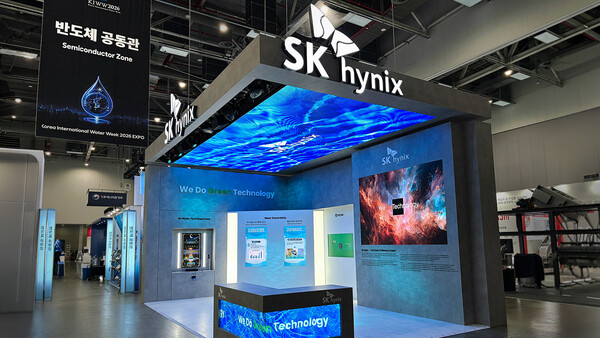
SK hynix said on Wednesday it saved an average of 170,000 tonnes of water a day last year at its domestic sites. That is equivalent to the amount of household water about 550,000 people can use in a day. SK hynix took part in Korea International Water Week 2026, held at EXCO in Daegu from Sept. 9 to 11, and introduced the water management results. The event is a forum where domestic and overseas governments, public institutions, companies and experts discuss ways to address water issues. About 80 companies and institutions from around 50 countries took part this year.
SK hynix formed a task force in 2018 to cut water use and expand reuse. Cumulative savings surpassed its target of 264 million tonnes and reached 303.37 million tonnes by last year. Its target for this year was raised to 329 million tonnes. It plans to save a cumulative 600 million tonnes of water resources by 2030.
It is also working to expand reuse, which involves reusing water after it has been used once. The amount of water reused rose to 73.59 million tonnes last year from 47.88 million tonnes in 2022. That represents a 54 percent increase in four years.
By site, the company is expanding the scope of reuse in line with process characteristics. The Icheon site produces 94,400 tonnes a day of reused water through wastewater reuse facilities and supplies it to air pollution prevention facilities and other uses. The Cheongju site in 2023 became the first in South Korea’s semiconductor industry to introduce reused water treated at an external sewage treatment facility, reusing already-used water as industrial water. It is also strengthening end-to-end management from intake and use through reuse and discharge. Advanced treatment processes have been applied at the wastewater treatment stage, including an ozone oxidation unit, activated carbon and a multi-stage coagulation and sedimentation system, and the company said it is continuing technology development and investment to reduce pollutants.
An SK hynix official said the company would continue to upgrade its water management system to use less water, which is essential for semiconductor production, and to reuse water as much as possible. The official said it would also steadily expand investment in process improvements and related technologies and equipment.
 Suk Daegun
d2dg@d-today.co.kr
Suk Daegun
d2dg@d-today.co.kr