
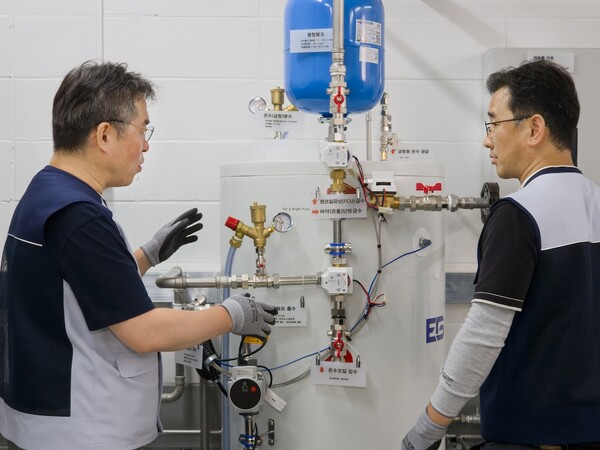
Samsung Electronics said on Sept. 10 it has newly set up a dedicated EHS heat pump training center at its CS Academy in Suwon, Gyeonggi province, and will strengthen its training system for B2B partners and installation engineers. The government is pushing to supply 3.5 million high-efficiency heat pumps by 2035, and Samsung Electronics plans to enhance its on-site response capabilities in line with that policy direction.
The EHS heat pump is an integrated solution that uses heat in the air and electricity to provide heating and cooling and hot water at once. Existing boilers that burn fossil fuels cannot exceed 100 percent energy efficiency, but this product can generate more heat relative to input energy. Performance, however, is often influenced more by piping installation and maintenance standards than by the product itself. That is why Samsung Electronics has made securing installation and service expertise a task.
The new training center has equipment identical to actual installation sites, including a thermal storage water tank, a hot-water control kit, an underfloor heating manifold, water piping facilities and fan coil units (FCUs). Engineers can practice water piping work and product installation, as well as commissioning and inspections using HASS (Home Appliances Smart Service), an AI-based appliance diagnostic program. In-house EHS masters and external experts in boilers and water piping will serve as instructors to build practical capabilities.
In April, training on thermal storage systems that convert and store surplus power into thermal energy was held for about 200 installation engineers in Jeju, where the share of solar power generation is high. Samsung Electronics plans to build a domestic production line for EHS heat pump boilers at its Gwangju plant and start mass production from the end of September, and it aims to respond to the spread of heating electrification in South Korea by securing both production and training infrastructure.
Samsung Electronics also operates HVAC specialist training in the Netherlands, the United States and Britain to raise product knowledge and installation and maintenance capabilities for B2B partners and engineers. It is also carrying out technology verification. At the Samsung HVAC Test Lab in Asahikawa, Hokkaido, Japan, it tests performance in severe cold and heavy snow, and it is developing next-generation technology through industry-academia cooperation with the KTH Royal Institute of Technology in Sweden and Korea University, among others. In June, the first EHS heat pump boiler was installed in a detached house in Aewol-eup, Jeju city, and the EHS All-in-One, which combines heating and cooling and hot water into one system, is being demonstrated. At Samsung C&T's Residential Performance Research Institute in Yongin, it is verifying the feasibility of application to apartment housing.
Lim Seong-taek (임성택), a vice president at Samsung Electronics' Digital Appliances Business, said heat pumps are a key solution for implementing high-efficiency, eco-friendly heating and that it is important to have professional installation, commissioning and service capabilities. He said the company will continue to expand specialist training and service infrastructure, following the establishment of a domestic production base, to actively respond to the spread of heating electrification in South Korea.
 Daegeon Seok
d2dg@d-today.co.kr
Daegeon Seok
d2dg@d-today.co.kr