
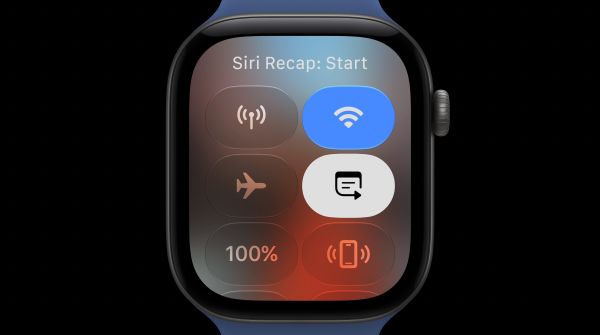
[Digital Today reporter Seung-a Yoo] Apple has introduced Siri Recap on a new Apple Watch, a feature that summarises conversations in real time and leaves them as notes. Apple stressed it does not record or store audio, but concerns have been raised that the feature processes everyday conversations nearby in real time, potentially fuelling privacy infringement controversy.
On Sept. 9 (local time), multiple foreign media outlets, including IT publication TechRadar, reported that Apple added new audio intelligence features to the recently unveiled Apple Watch Series 12 and Apple Watch Ultra 4. Siri Recap runs in a new Siri application and uses the watch's built-in microphone, the S11 chip and Apple Intelligence to summarise a user's conversations into high-level notes. Users can set when and where the feature operates, or turn it on and off as needed.
The key point is that it does not work by recording and storing audio. Apple explained that it does not create or store audio recording files, and that the raw audio used for processing cannot be accessed by the operating system, apps, the user or Apple. Siri Recap creates a short note with a title, summary and key points instead of a transcript showing the full conversation. Apple said, "There is no recording file to share, deliver or submit even if any party requests it. That is because no such recording exists."
But concerns about privacy protection follow along with convenience. It is not new for smartwatches or smart speakers to detect surrounding sound to recognise a wake word, but Siri Recap differs in that it continuously processes and summarises a user's conversations. In particular, if the conversation partner does not know whether the feature is running, they may feel their conversation is being processed without consent.
Apple also introduced another audio intelligence feature for the watch called Live Rewind. If a user presses the digital crown twice, it shows a text view of the previous 15 seconds of conversation. It can be useful for accessibility by allowing users to check what they did not hear well, but it could also make people nearby uncomfortable because it lets the wearer revisit what others said.
Apple also highlighted privacy safeguards. It said the audio intelligence features process raw audio immediately and then delete it, and that they process audio in an isolated state through Secure Enclave, a security area built into the Apple Watch's S11 chip that separates the audio from the system. It said Siri Recap summary data is processed in Private Cloud Compute and cannot be accessed by Apple or other entities. Saved Siri Recap summaries are automatically deleted after 7 days, and data saved by the user is end-to-end encrypted and synced with iCloud.
Still, it is unclear whether discomfort over always-listening functions in wearable devices will easily subside despite Apple's explanations. Pointing to cases in which Meta's smart glasses faced backlash over restrictions in public places or concerns about covert filming, some say the Apple Watch could also become embroiled in similar controversy.
Apple has moved to build trust by emphasising on-device artificial intelligence and privacy protection, but how actual users and people around them will accept the feature is a separate matter. In particular, if people nearby who are not users feel their conversations are being processed without consent, it could affect the spread of the new audio intelligence features, observers say.
Siri Recap and Live Rewind are expected to be offered in a beta version in the second half of 2026. Whether Apple Watch audio intelligence becomes a new convenience feature is expected to depend not only on the feature itself but also on how much user trust it can secure on privacy protection.
 Seung-a Yoo
ysah@d-today.co.kr
Seung-a Yoo
ysah@d-today.co.kr