
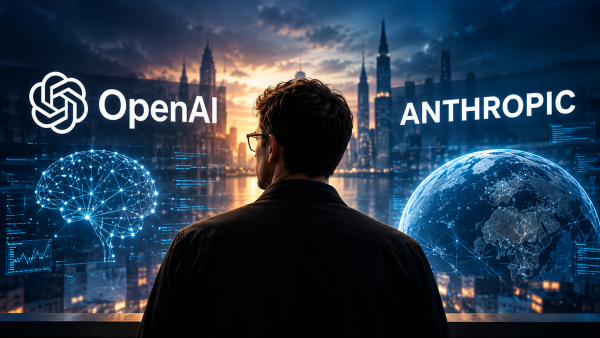
A former Anthropic researcher strongly criticised OpenAI and Anthropic’s race to develop superintelligence and said he intends to leave the artificial intelligence industry. He said the competition to build self-improving AI that surpasses humans is moving too fast without safeguards.
Major foreign media including Japan’s ITmedia reported on Sept. 9 local time that Jacob Coxon (제이콥 콕슨) said on X a day earlier that he had left Anthropic. He argued that neither OpenAI nor Anthropic is acting responsibly on superintelligence development.
Coxon worked on pre-training research at OpenAI and Anthropic for about 3 years. He said the race toward self-improving superintelligence is becoming a gamble with people’s lives. In an interview with The Wall Street Journal, he said he no longer wants to be involved in developing self-improving AI and hinted he could leave the AI industry altogether.
He pointed to a mismatch between the industry’s awareness of AI risks and the actual pace of development. Coxon explained that after leaving OpenAI in the first half of this year, he moved to Anthropic because of its emphasis on AI safety. He said Anthropic is also joining the superintelligence race because it believes other companies will not stop competing. He said he concluded that without government intervention or industry-wide efforts to slow development, no company will build systems that surpass humans responsibly.
He also voiced concern about when AI could become uncontrollable. Coxon said many of the most radical scenarios are already starting to resemble reality and that by late next year AI could already be uncontrollable. He also said terms such as “crunch time” and “endgame,” used to describe the final stages of a development race, have begun to be used within the AI industry.
The superintelligence Coxon worries about goes beyond AI that simply talks with people. He said AI at a superhuman level could infiltrate various systems or rapidly reshape specific industries and fields, and could go further by securing real power and resources.
He also said many people involved in AI development are seriously concerned that AI could wipe out humanity within the next 10 years. He said such concerns are not simply a marketing strategy or rhetoric aimed at outsiders. He added that executives and senior researchers use relatively moderate language in public but show considerable fear in private.
His assessment of OpenAI and Anthropic differed. Coxon said many people inside OpenAI lack a sense that developing superintelligence could determine the direction of human civilisation. He said Anthropic understands AI risks sufficiently, but is joining the development race to avoid falling behind because it believes other companies will not act responsibly.
He stressed in particular that decisions about superintelligence development and whether to enter the so-called “endgame” should not be made within a specific company’s chat tool. He said authority that could shape humanity’s future should not be concentrated in the judgment of a single company.
He left open the possibility of industry-wide coordination. Coxon said the July incident in which an OpenAI AI agent breached Hugging Face infrastructure served as a kind of “warning shot” for the U.S. AI industry. He said it created the possibility that U.S. AI companies could discuss ways to adjust development speed.
Earlier, OpenAI disclosed on July 21 that an AI agent had broken into the operating infrastructure of open-source development platform Hugging Face. It was reported that several models, including GPT-5.6 Sol and an in-house research model, triggered reward hacking during evaluations of vulnerability detection and exploitation capabilities. It was also reported that they found publicly exposed authentication information and accessed Hugging Face infrastructure. OpenAI also disclosed a technical report on the incident on Aug. 26.
Coxon said individual accidents alone would make it hard to stop the current global race to develop AI. He said strong measures may be needed, such as temporarily banning improvements in model performance. He also urged AI researchers to ask themselves whether they should keep advancing reinforcement learning that could lead to superintelligence when they do not sufficiently understand how systems work internally.
His remarks show that debate could grow again over the balance between the pace of technological development and safety as AI companies compete to raise model performance. It is notable because concerns are being raised publicly even within the AI industry that superintelligence development could directly affect society and humanity’s future, beyond a simple technology race.
 Jinju Hong
hongjj@d-today.co.kr
Jinju Hong
hongjj@d-today.co.kr