
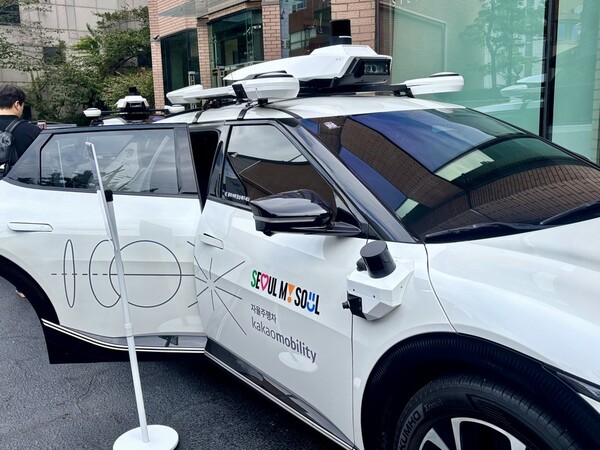
Kakao Mobility's autonomous driving development is shifting from collecting large amounts of driving data to selecting data from difficult situations. Based on the data it has secured, Kakao Mobility plans to integrate perception and decision-making into a single end-to-end (E2E) model within this year.
In-ho Lim (임인호), leader of the AI Driving Part at Kakao Mobility's autonomous driving development team, said at a media study event on Tuesday that the key to recent AI competition is efficiency in picking out difficult data from vast datasets.
An E2E model is a method in which a single AI takes in what sensors see and outputs driving actions directly. Instead of transcribing driving rules line by line into a machine, it can teach an AI driving intuition by watching countless driving records.
Kakao Mobility began a late-night autonomous driving service in Gangnam with its own technology on March 16 and exceeded 2,000 completed trips and 13,000 km in cumulative distance through Aug. 31. Kakao Mobility explained that it uses driving records accumulated during that period as AI training assets.
Kakao Mobility classifies the data by dividing driving situations into five levels. Level 1 follows signals and rules, Level 2 focuses on defensive driving, Level 3 reads relationships with nearby vehicles and changes lanes or makes left and right turns, Level 4 responds to cutting-in vehicles and motorcycles, and Level 5 responds to risks that are difficult to predict. Driving difficulty rises in the higher levels, but the amount of data decreases.
Lim explained that Levels 4 and 5 are the segments that distinguish autonomous driving capability and that data from those segments is the rarest. He said data volume and driving performance are proportional only up to a certain point, and beyond a specific segment, performance improvement varies even with the same amount of data. He stressed that it is data that creates that gap.
Kakao Mobility referred to such rare data as edge cases. Kakao Mobility's autonomous vehicles automatically detect and store such situations. It classifies the moment autonomous mode switches to manual mode as an exceptional situation and records the segments before and after it together.
Examples include a vehicle making an illegal U-turn at dawn, a segment where it had to cross the centre line due to sewer pipe construction, and an intoxicated person darting out onto a main road near Gangnam Station. The collected records become training data through a five-level cyclical structure. Work that previously involved people reviewing and judging frame by frame is now handled by AI within tens of minutes after server upload. Lim said, "For the AI model, driving for one month in Gangnam is far better than driving for one year in a low-difficulty area."
◆E2E integration targeted for year-end... Gangnam edge cases as training assets
A simulator fills the gap created when only accident-free data accumulates. If AI learns only from driving records without accidents, it can suffer from survivor bias in which it cannot learn accident situations themselves. Lim said, on the premise that there have been no personal-injury or property-damage accidents attributable to the company so far, it is intentionally creating accident situations in a simulator for verification. He explained that it checks via simulation how a vehicle would have reacted if an actual collision had occurred and how it would defend itself in situations where other vehicles attack the autonomous vehicle.
This data foundation has been built on eight years of demonstrations. Kakao Mobility launched an autonomous driving task force in 2018, received temporary operation approval from the Ministry of Land, Infrastructure and Transport in March 2020, and ran a passenger transport service in Pangyo in December 2021. In September 2024, it took charge of integrated operations of Seoul's autonomous driving transport platform, and started the Gangnam late-night service with two vehicles on March 16 this year, increasing the fleet to six on Aug. 20.
Kakao Mobility plans to use the data it has secured to shift its decision-making algorithm structure. Through 2025, it used a three-stage modular structure separating perception, decision-making and control, and in the first quarter of this year it split the decision-making domain into a rules-based planner and an AI planner. The year-end goal is to integrate perception and decision-making into a single E2E model, with a rules-based safety evaluator verifying the results before passing them on as control commands.
Lim expected the E2E shift to reduce errors in the perception stage and improve behaviours that made passengers uncomfortable, such as sudden deceleration caused by misrecognition. Lim said, "The path to autonomous driving is clear," adding, "an E2E model designed with safety as the top priority, and high-quality data for smarter autonomous driving."
 Dae-geon Seok
d2dg@d-today.co.kr
Dae-geon Seok
d2dg@d-today.co.kr