
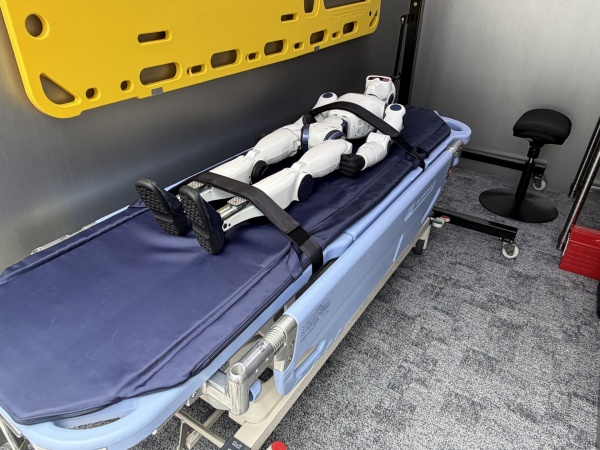
A dedicated vehicle to diagnose and repair broken humanoid robots on site has appeared in Japan. As humanoid robots become more widespread, forecasts say maintenance systems that can quickly restore robots after faults will become as important as the robots’ performance.
IT Media in Japan reported on Monday that GMO AI&Robotics Trading Co (GMO AIR) unveiled the “GMO Humanoid Ambulance,” specialised for humanoid robot maintenance. The company said it is Japan’s first dedicated vehicle for humanoid maintenance.
GMO AIR plans to run the service by dispatching the vehicle to a site when a humanoid robot shows abnormalities or breaks down to inspect and repair it. The vehicle carries a replacement humanoid unit, key parts and consumables, replacement parts and diagnostic equipment.
An engineer who normally handles humanoid tuning also goes to the site. The engineer checks the robot’s condition and replaces parts or repairs it as needed.
If repairs cannot be completed on site, the robot is moved to locations such as the AI development base “GMO Humanoid Lab” in Shibuya, Tokyo, for additional servicing. This amounts to a maintenance system that runs from site dispatch to precision repair.
Inside the vehicle, space has also been set aside to load a stretcher dedicated to humanoids and repair equipment. It was produced with a design reminiscent of a typical ambulance, using a white body with red lines. The company said it was designed by Yasumichi Morita (모리타 야스미치), CEO of Granmanas, which handles product design, and that it took into account visibility and functionality by referencing emergency vehicles around the world.
The maintenance service is also linked to existing subscription products. If repairs take a long time, users can receive a replacement unit on site through a 70,000 yen-a-month subscription service. The service is designed to allow use of a replacement unit for up to a total of 1.5 months a year at no additional cost.
One factor that led GMO AIR to focus on a humanoid maintenance system was the “World Humanoid Robot Sports Games” held in Beijing, China, in August. At the time, GMO AIR took part in the 100 metres, 400 metres and 1,500 metres events using a customised unit built on China-based Unitree’s humanoid robot “G1.” During the 400 metres heats, the robot fell and its head was damaged.
An on-site engineer restored the robot in about 10 minutes using spare parts. Only about 20 minutes remained until the semifinals, but the unit could be put back into the stadium.
The experience became a case showing the importance of maintaining humanoid robots. Shota Takizawa (타키자와 쇼타), a senior research engineer at GMO AIR, said it varies depending on the purpose and method of use, but that in his experience, after about three months of use, 30 to 40 percent of humanoids suffer some form of part failure.
He also said that in the process of validating intense movements, most humanoids have experienced a breakdown. That means maintenance demand could grow because as humanoids implement more human-like movements, repeated loads build up on joints and drive systems.
GMO AIR sees maintenance and operating systems emerging as key competitiveness if social use of humanoids expands. Tomohiro Uchida (우치다 도모히로), CEO of GMO AIR, said at a presentation event that as humanoid robots expand into society and are used in harsher environments and for harsher purposes, failures and demand for maintenance will also increase.
As a result, this dedicated ambulance for humanoids is seen as an attempt to build operating infrastructure for a humanoid business ahead of a simple promotional device. As humanoids spread, forecasts say competition will hinge not only on performance but also on how quickly a service can restore a unit and deploy a replacement after a disruption.
 Jinju Hong
hongjj@d-today.co.kr
Jinju Hong
hongjj@d-today.co.kr