
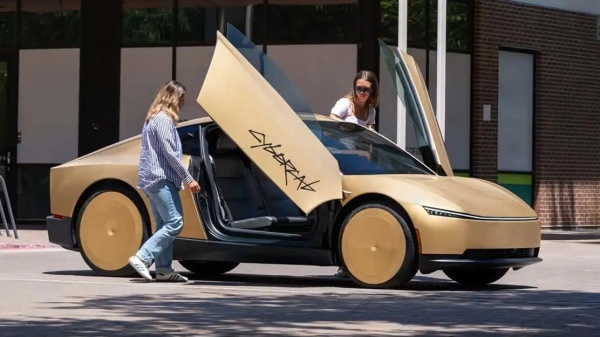
[DigitalToday reporter Jinju Hong] Tesla has begun deploying its autonomous robotaxi, Cybercab, which completely removes the steering wheel and brake pedal, on roads in Austin, Texas. Attention is growing, from vehicle design to its self-driving strategy.
The company is known to have applied a motor that does not use rare earths and a braking system different from conventional vehicles. It is drawing attention to whether Tesla can secure competitiveness in the autonomous driving market through its distinctive technology choices.
• Tesla begins public operations of its 'Cybercab'... Will Elon Musk-style self-driving strategy succeed? • Tesla unveils rare earth-free 'Cybercab' motor... Expectations for supply-chain change are 'not so sure' • Does Tesla Cybercab have no hydraulic brakes? Then how does it stop?
The operation is Tesla's first real service for the robotaxi concept it has previewed for years. Still, usage conditions are strict, including that children under 13 cannot ride in Cybercab. As it expands operations centered on Austin, attention is also focused on the functions and limits Cybercab can deliver on real roads.
The timing of general sales of the vehicle also remains unclear, leaving a sizable gap between the robotaxi business and the launch of a consumer vehicle.
• Tesla 'Cybercab' takes its first step in commercial operation... What it can and cannot do • Tesla steps up promotion of Cybercab ahead of Austin event... focus on expansion of driverless robotaxis • Despite Tesla deploying Cybercab robotaxi, MKBHD says 'general sales will be difficult within this year'
As Tesla speeds up its expansion of driverless robotaxis, competitors are also pushing back by widening service areas and use cases.
Uber has broadened its reach into the global market by starting commercial service in London, and a former Uber CEO is also trying again in the autonomous driving market with Atomsworth 2 trillion won. Amazon's Zoox expanded its operating range to Las Vegas airport. Unlike Tesla, which is focusing on vehicle and technology development, competitors appear to be moving to pre-empt the robotaxi market by rapidly increasing real service touchpoints.
• Uber enters London, beating Waymo... launches commercial service without geofencing • Former Uber CEO returns to robotaxis... tries again in autonomous driving with 2 trillion won Atomsworth • Amazon Zoox expands to Las Vegas airport... robotaxis even for airport trips
South Korea's autonomous driving market is also expanding beyond vehicle technology to building infrastructure and an industrial ecosystem to support real-world operations.
Humax Mobility launched a consultative body for robotaxi operating infrastructure, and RideFlux moved to cooperate with Tata Daewoo Mobility on Level 2+ autonomous driving technology. Kakao Mobility also stressed that urban infrastructure itself must be redesigned for the era of autonomous driving, as the domestic industry appears to be accelerating efforts to lay the groundwork for commercialisation.
• Humax Mobility launches consultative body for robotaxi operating infrastructure • RideFlux signs Level 2+ autonomous driving MOU with Tata Daewoo Mobility • Kakao Mobility CEO Geung-seon Ryu (류긍선) says, "Autonomous driving requires redesigning even urban infrastructure"
Other domestic mobility platforms are also moving to expand everyday services that use mobility data.
Tmap introduced a 'driving pedometer' that shows driving records like step counts and strengthened its rewards services. Whistle is expanding its parking enforcement alert service to 7 cities and counties in North Jeolla Province, improving convenience for drivers.
• Tmap launches 'driving pedometer'... completes a rewards system covering overall mobility • Whistle expands enforcement alert service to 7 cities and counties in North Jeolla
Cases are continuing to counter worries about battery durability and vehicle safety surrounding electric vehicles. As models that maintained battery performance at a high level even after long-distance driving draw attention, three Chinese electric vehicle models earned Euro NCAP's top rating of 5 stars, offering rebuttal cases to safety controversies over China-made electric vehicles.
• EV batteries keep in the 90 percent range even after 150,000 km... 7 models with standout durability • 3 Chinese EVs earn top '5-star' score in Euro NCAP... directly rebut safety concerns
Electric vehicles are also rapidly narrowing the territory of internal combustion-engine cars by highlighting not only driving performance but also competitiveness in price and maintenance costs. Range Rover unveiled its first electric vehicle that keeps its existing luxury SUV design while electrifying it. In Europe, the gap in price and running costs between electric vehicles and internal combustion-engine cars is narrowing, boosting market competitiveness.
• Looks the same outside but electric inside... Range Rover unveils first EV • Electric vehicles keep gaining... in Europe, both prices and running costs chase internal combustion
Moves by South Korea's finished-vehicle industry targeting both premium segments and mass adoption at the same time are also drawing attention.
Genesis is targeting the flagship SUV market with a range of exterior colours and personalisation options for the GV90. Kia is also accelerating EV mass adoption by setting a new sales record in the United States and putting forward the EV3, an electric vehicle in the $30,000 range.
• Genesis GV90 offers 16 exterior colours... aims for a personalised flagship SUV • Kia sets August sales record in the U.S.... targets EV mass adoption with '$30,000-range' EV3
 Jinju Hong
hongjj@d-today.co.kr
Jinju Hong
hongjj@d-today.co.kr