
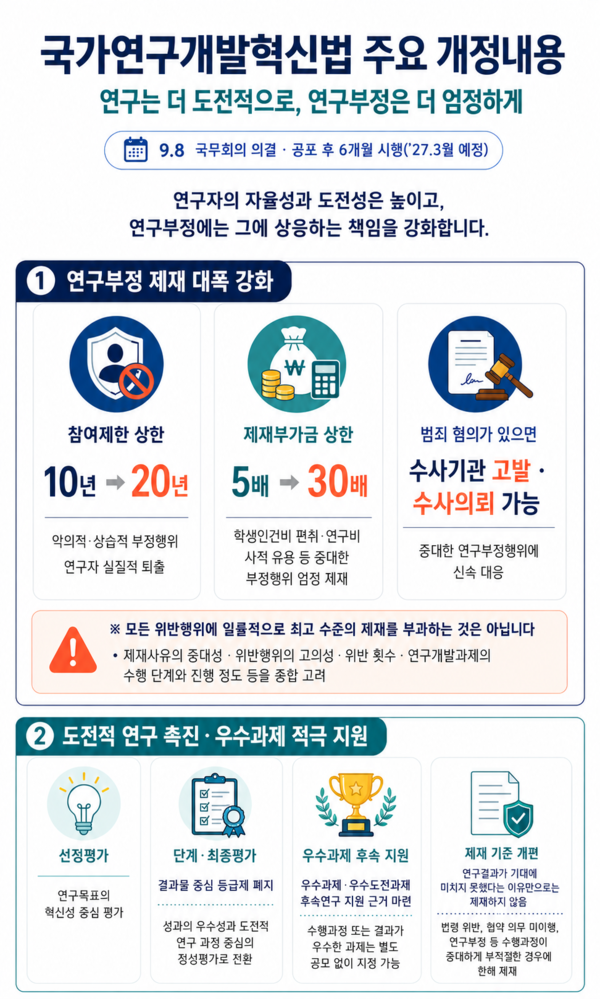
The maximum ban period for participation in national research and development (R&D) will be extended to 20 years from 10 years for serious research misconduct. The cap on penalty surcharges imposed for fraudulent use of government-funded R&D money will also be sharply raised to 30 times the amount paid from five times.
The Ministry of Science and ICT said a plan to promulgate partial amendments to the National Research and Development Innovation Act, which passed the National Assembly plenary session on Aug. 20, was reviewed and approved at a Cabinet meeting on Sept. 8. The revised law will take effect in March 2027, six months after promulgation.
The bill focuses on expanding researchers' autonomy and willingness to take on challenges while strengthening accountability for research misconduct. The maximum ban period for participation in national R&D activities for research misconduct will be expanded to 20 years from the current 10 years. The cap on penalty surcharges will also rise to 30 times from five times the government-funded R&D money already paid.
Under the changes, researchers who maliciously or repeatedly misuse research funds can be barred from participating in national R&D activities for up to 20 years. For serious research misconduct such as embezzling student labor costs or using research funds for private purposes, penalty surcharges of up to 30 times the government-funded R&D money can be imposed.
The highest level of sanctions will not automatically apply uniformly to all violations. The punishment level will be decided by comprehensively considering the seriousness and intent of the grounds for sanctions, the number of violations, and the stage and progress of the R&D project.
The changes also establish grounds to respond to research misconduct suspected of being criminal. If the head of a central administrative agency judges there are reasonable grounds to believe there is a criminal suspicion, the agency can file a complaint with the relevant investigative body or request an investigation.
The project evaluation system will also be overhauled to promote challenging research. The government will focus on evaluating the "innovativeness of research goals" from the project selection stage and plans to actively support research that presents higher-level goals than safety-oriented projects. In stage and final evaluations, it will shift to qualitative assessments centered on "excellence of outcomes" and the "process of conducting challenging research" in line with abolishing result-oriented grading.
Not only excellent projects with large academic and technological ripple effects, but also "excellent challenge projects" that create outstanding knowledge through trial and error even if they fail to achieve innovative goals, can receive support for follow-up research. For projects with excellent processes or results, follow-up research can be supported by designating the relevant principal investigator or research institution without a separate call for proposals.
The standards for sanctions on projects with extremely poor research results will also change. Sanctions will be allowed only when there are serious problems in the execution process, such as legal violations, failure to fulfill contractual obligations, or research misconduct, rather than simply because expected results were not produced.
The ministry plans to revise subordinate regulations, including the enforcement decree of the National Research and Development Innovation Act, by March 2027, when the law takes effect.
Park In-kyu (박인규), head of the Science and Technology Innovation Office, said, "We will further expand research autonomy so researchers can take on challenges without fear of failure, and more boldly support sincere challenges and excellent research to establish an innovative research ecosystem based on trust and responsibility."
 Jin-ho Lee
jhlee26@d-today.co.kr
Jin-ho Lee
jhlee26@d-today.co.kr