
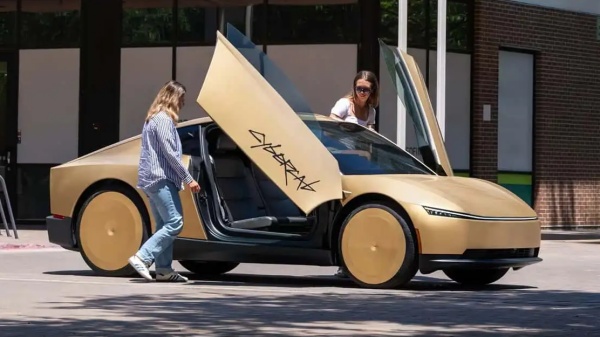
Tesla’s driverless robotaxi, the Cybercab, has come under a U.S. federal government review of safety standards shortly after it began carrying regular passengers.
According to foreign media including tech outlet Ars Technica on Sept. 5 local time, the National Highway Traffic Safety Administration (NHTSA) has started an “audit query” to examine the basis and procedures behind Tesla’s determination that the Cybercab meets current federal motor vehicle safety standards. The review covers the self-certification process for up to 1,000 Cybercabs and related technical materials.
The Cybercab is a two-seat vehicle with no steering wheel and no brake pedal. Tesla is deploying the Cybercab in its robotaxi ride-hailing network operating in some cities in Texas and Florida. Earlier, Tesla held a driverless Cybercab ride event for hundreds of fans in downtown Austin, Texas, and then began service for regular passengers. The Texas state database currently lists 45 Cybercabs registered under Tesla’s vehicle fleet.
The issue is that Tesla has determined it can operate the Cybercab without obtaining a separate exemption approval under federal regulations. Current federal motor vehicle safety standards assume a driver directly controls the vehicle and require manual controls such as a steering wheel and brake pedal. NHTSA is revising eight standards tied to equipment considered less necessary for driverless vehicles, such as brake pedals, wipers and rearview mirrors, to make it easier to introduce autonomous vehicles, but the revisions are not yet complete and existing standards apply.
As a result, companies seeking to operate autonomous vehicles with unusual designs have obtained federal regulatory exemptions before carrying passengers. Amazon subsidiary Zoox received the first federal exemption approval from the U.S. government for a robotaxi without a steering wheel and manual controls, and its fleet size this year is limited to 2,500 vehicles. Tesla, however, says no separate exemption approval is needed because the Cybercab meets existing safety standards.
The audit query focuses on confirming what data and procedures Tesla used to determine that the Cybercab meets federal safety standards. Jonathan Morrison (조너선 모리슨), NHTSA’s chief counsel, said he fully supports the safe development and deployment of autonomous vehicles, but as a federal regulator it must ensure all laws are followed.
The review could also affect actual business operations. NHTSA can require automakers to change vehicles or related procedures if needed, and it can take enforcement actions such as civil penalties. Volvo Group North America paid a $130 million fine and agreed to three years of third-party oversight after an investigation into its recall process.
Ann Carlson (앤 칼슨), former acting head of NHTSA and a UCLA environmental law professor, said the review could be a sign that NHTSA has significant dissatisfaction with Tesla. She said the Zoox case made clear that authorities require exemption procedures for autonomous vehicle developers, and pointed out that Tesla not following that was highly unusual.
The Cybercab also symbolizes the future Tesla is pursuing. Elon Musk has stressed that Tesla should be seen not as a simple carmaker but as a robotics and autonomous vehicle company. Tesla is pursuing a long-term plan to deploy Cybercabs at an annual scale of millions of units. That has led to observations that the review could affect not only whether the Cybercab complies with safety standards but also Tesla’s robotaxi expansion strategy and the pace of commercialization.
 Seung-ah Yoo
ysah@d-today.co.kr
Seung-ah Yoo
ysah@d-today.co.kr