
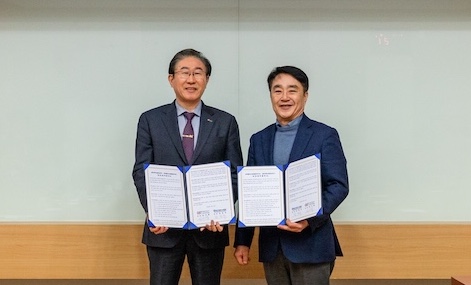
Gwangju Institute of Science and Technology (GIST) and the Korea Fabless Industry Association (KFIA) said on Tuesday they have signed a memorandum of understanding to strengthen the AI semiconductor industry’s global competitiveness. The agreement is designed to combine GIST’s AI and semiconductor R&D capabilities with KFIA’s on-the-ground industry network to build a full-cycle AI semiconductor ecosystem spanning design, fabrication and packaging, and verification. It aims to link university research results to real technologies and products in industry.
KFIA is the leading industry body representing fabless companies specialising in semiconductor design. Under the agreement, it will play a key role in providing field-oriented data, setting education and research directions based on industry demand, and participating in joint R&D and government projects.
To address a lack of infrastructure for advanced process verification and technology validation faced by fabless companies, the two sides will jointly build verification environments and support high-difficulty semiconductor R&D that individual companies struggle to undertake alone.
GIST plans to use the agreement as a starting point to become a research-driven university with integrated, full-cycle capabilities. It aims to connect AI semiconductor design to back-end processing and packaging, then to verification in real industrial settings such as energy, mobility and smart manufacturing, and ultimately to a transition in which AI technology spreads across industry.
GIST is building, with government support, an “AI semiconductor advanced process fab” that spans stages from producing basic semiconductor materials to front-end and back-end processes, with the goal of developing next-generation semiconductors such as AI semiconductors and training talent. It is expected to serve as the agreement’s base for verification and research.
Based on the agreement, the two organisations plan to proceed step by step with identifying joint R&D projects, developing customised education programmes based on industry demand, and jointly participating in projects linked to the government and local governments. They aim to generate results from the second half of 2026 by accelerating the build-out of packaging and back-end process verification infrastructure centred on technology validation and a regional AX verification platform.
GIST President Im Ki-cheol said GIST, as a research-driven university representing the Honam region, is the optimal anchor institution to implement in the southern region a “Vortex University” model in which talent, companies and capital gather, like Stanford University and the University of California, Berkeley in Silicon Valley. He said GIST will do its best, through close cooperation with KFIA, to enhance the global competitiveness of South Korea’s AI semiconductor industry and help the southern region grow into a full-fledged semiconductor cluster.
KFIA Chairman Kim Kyung-soo said one of the biggest difficulties facing fabless companies is a lack of infrastructure for advanced process verification and validation. He stressed that the MOU will accelerate efforts to secure core technologies in AI semiconductors and train talent tailored to industry demand by combining the two sides’ research capabilities and field expertise. He said the effort will help revitalise the domestic fabless ecosystem and take the lead in strengthening the national competitiveness of South Korea’s AI industry.
 Seok Dae-geon
d2dg@d-today.co.kr
Seok Dae-geon
d2dg@d-today.co.kr