
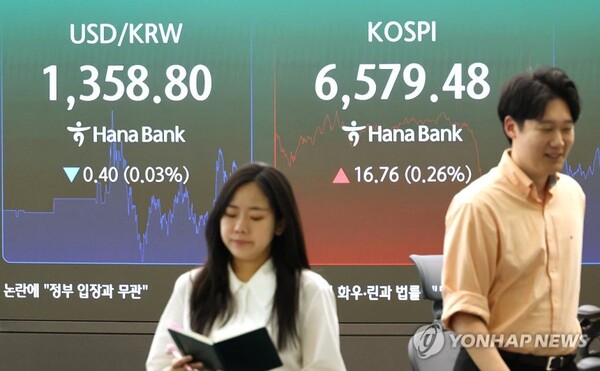
The KOSPI ends slightly higher after showing sharp volatility, including a slide to the 6,400 level during the session. Bargain hunting follows the previous day's nearly 4 percent plunge and helps pare losses, but semiconductor shares such as Samsung Electronics and SK Hynix extend declines.
On Sept. 3, the KOSPI closes up 16.76 points, or 0.26 percent, at 6,579.48 from the previous session.
The index opens up 87.61 points, or 1.34 percent, at 6,650.33, then selling expands and it plunges to the 6,400 level. It recoups losses late in the session and turns higher.
In the main bourse, retail investors sell a net 955.0 billion won, foreigners sell 423.3 billion won and institutions sell 215.3 billion won.
Among top market-cap stocks, semiconductor shares remain weak. Samsung Electronics closes down 0.20 percent at 250,000 won, while SK Hynix ends down 1.05 percent at 1,596,000 won.
Elsewhere, SK Square falls 0.10 percent, Samsung Electro-Mechanics drops 3.71 percent, and Samsung Biologics and Samsung C&T slip 1.60 percent and 0.27 percent, respectively.
By contrast, LG Energy Solution rises 5.18 percent to 365,500 won and KB Financial Group gains 5.20 percent to close at 177,900 won. Samsung Life climbs 3.06 percent and Hyundai Motor rises 1.46 percent.
The KOSDAQ extends weakness. It closes down 13.77 points, or 1.71 percent, at 790.21, falling below the 800 level.
In the Seoul foreign exchange market, the won-dollar exchange rate is 1,358.30 won per dollar, down 2.00 won from the previous session.
In the securities industry, analysts view bargain buying after the previous day's plunge and easing of the surge in U.S. 10-year Treasury yields as factors behind the rebound. Strong results from Broadcom are also seen as having helped improve investor sentiment.
Still, the domestic stock market has recently repeatedly seen a "sell-on" phenomenon, where share prices weaken after companies announce positive news.
Han Ji-young (한지영), a researcher at Kiwoom Securities, analyses this as a supply-demand factor driven by macroeconomic uncertainty rather than a fundamental problem at individual companies.
She explains that U.S. long-term yields need to stabilise and a base of new buying needs to recover for company-specific positive news to be reflected normally in share prices.
 Oh Sang-yup
yub@d-today.co.kr
Oh Sang-yup
yub@d-today.co.kr