
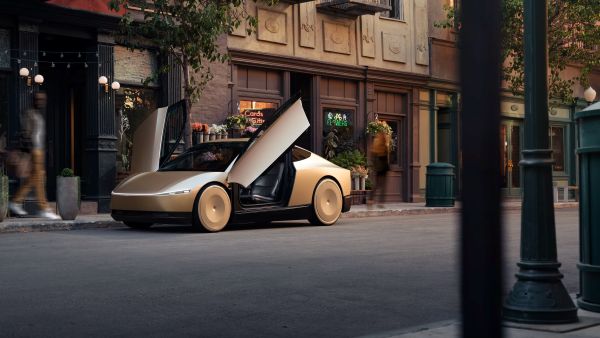
Tesla is signalling a major product event as it is set to roll out the Cybercab and the Semi in September, with a possibility of unveiling the next-generation Roadster as well. All three are not new projects but models that were revealed years ago or promised for launch, putting Tesla's execution and supply capacity back to the test.
On Sept. 1, electric vehicle outlet Electrek reported that Tesla plans to launch the Cybercab on Sept. 3. It is also reported to hold an official launch event for the Semi electric truck later this month. Tesla chief designer Franz von Holzhausen has said the next-generation Roadster will be released "very soon", fuelling talk of a possible September unveiling.
The Cybercab is the product drawing the most immediate attention. It is being developed as a two-seat, fully autonomous robotaxi with no steering wheel or pedals. Tesla unveiled the Cybercab in 2024, but it has pursued the robotaxi concept using fully autonomous vehicles for much longer. Chief Executive Elon Musk (일론 머스크) in 2016 laid out a plan in which owners who bought full self-driving software could operate their cars as self-driving taxis to generate income.
At the time, Tesla called it the "Tesla Network". The name later changed to robotaxi, but the current concept has moved closer to a model operated directly by Tesla. Critics also say it is still too early for ordinary consumers to use their vehicles as self-driving taxis in the same way.
Technical maturity is also a central issue for the Cybercab. The Cybercab assumes it will operate with no driver at all, but criticism has persisted that neither the consumer version of full self-driving software nor the robotaxi-specific version has reached a level that enables continuous driverless operation.
The key question for this launch, therefore, is how broadly a Cybercab that removes the steering wheel and pedals altogether can deliver driverless operation in practice.
The Semi is a signature product whose launch Tesla has delayed for a long time. It was first unveiled in 2017, with a 2020 launch projected at the time. Tesla stressed that the Semi could be competitive with diesel trucks on total cost of ownership and signalled changes in the freight market. Actual production and supply expansion, however, fell far behind the original plan.
The first Semi vehicles were delivered to PepsiCo and Frito-Lay in late 2022. Output has remained limited since then, and the first vehicle from a dedicated mass-production line rolled out only this year. With a separate official launch event scheduled this month, attention is growing over whether the Semi can actually move into mass production.
The most uncertain model is the next-generation Roadster. The Roadster was also first unveiled in 2017 alongside the Semi. Musk said at the time the Roadster would be a strong competitor to high-performance internal combustion sports cars. But as of 2026, no definitive launch schedule has emerged. A possible August demonstration was mentioned, but no event took place, and the launch timeline has been delayed multiple times.
The Roadster has also been tied to a concept of collaboration with SpaceX. Musk previously referred to a "SpaceX package" to boost vehicle performance and later made remarks suggesting the car could float or fly.
It has not been confirmed whether such functions will be applied to a production vehicle or how they would be implemented. Holzhausen's recent "very soon" remark is also raising expectations, but Tesla has yet to present a specific unveiling schedule or mass-production plan.
An analysis is emerging that the significance of Tesla's September event does not lie simply in unveiling new products. The Cybercab embodies a robotaxi concept that has continued since 2016, while the Semi is a model whose production expansion has been delayed since its 2017 debut. The Roadster is also a project that has faced years of launch delays.
Musk has also recently said a pothole-avoidance feature in full self-driving software is "coming soon", bringing renewed attention to features and products that have been teased for a long time.
As a result, the key focus in September is expected to be not the announcements themselves but the actual timing of execution, supply capacity and whether past promises are fulfilled. In particular, the real-world scope of driverless operation for the Cybercab, the scale of mass-production expansion for the Semi, and the physical unveiling and launch schedule for the next-generation Roadster are expected to be key variables shaping Tesla's September moves.
 Jinju Hong
hongjj@d-today.co.kr
Jinju Hong
hongjj@d-today.co.kr