
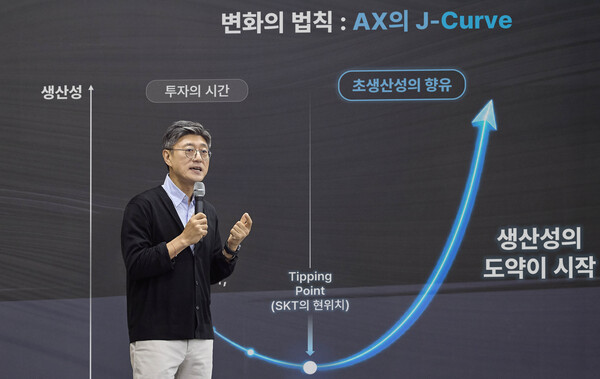
Jung Jae-heon (정재헌), CEO of SK Telecom, shared future strategy using AI technology and ways to use it properly from a Seoul National University lectern.
SKT said on Tuesday that Jung gave a special lecture on Sept. 1 at Seoul National University’s Building 1 of Engineering on the theme, "Choices and Opportunities in the AI Era".
The lecture was the first class of an AI joint programme SKT and Seoul National University have continued for 10 years. Jung, who entered Seoul National University’s Department of Law and Public Administration in 1987, returned to his alma mater as a lecturer for the first time in about 40 years. Jung said, "I did not come to teach technology, but to share what a company on the front line of AI transformation is thinking about now."
He said the advent of AI is changing the "density of time" an individual can use. Depending on how AI is used, he said, someone’s day can deliver productivity equivalent to 240 hours or 2,400 hours. He also stressed the importance of "sovereign AI" as AI competition spreads beyond companies to competition between countries. He said reliance on outside technology makes it difficult to decide prices and terms of use independently.
Jung presented "AX’s J-curve" drawn from SKT’s push for AI transformation over the past year, and proposed three work methodologies for the AX era: "seeing it anew," "facing the extreme" and "becoming uncomfortable."
The J-curve is an economics concept describing how a trade balance initially worsens after an exchange-rate change and then improves after some time. Jung applied it to AI transformation. He said productivity can fall at the start of AI adoption due to retraining, redesigning work and organising data and the organisation, but organisations that endure the process can later sharply lift productivity.
Jung said, "If you turn back in front of the valley of discomfort, you remain forever on the left side of the curve, but an organisation that endures it bends upward into a J at some point." He said, "Seeing it anew, facing the extreme and becoming uncomfortable are ways to cross this valley."
Specifically, "seeing it anew" means questioning the assumptions of existing ways of working again. SKT is applying to all tasks the question, "If we assume AI, how would we redesign this work?"
"Facing the extreme" is an approach that sets goals that are difficult to achieve with existing methods and looks for new solutions. A representative case is SKT’s development of its 688 billion-parameter hyperscale proprietary AI model, "A.X K2," with limited graphics processing unit resources.
"Becoming uncomfortable" means accepting trial and error that occurs early in AI transformation. One SKT developer previously spent about 50 hours modifying a system in response to customer requests. To shift this to AI, the developer spent more than 500 hours developing an AI agent and verifying it hundreds of times, but the time needed for the same work has now fallen to about 1 hour.
Jung stressed that "only when you go beyond familiar inefficiency and face the extreme at the edge of a cliff can you finally reach the hyper-productivity innovation of the 'J-curve.'"
He cited initiative, expertise and empathy as capabilities needed for talent in the AI era. Jung said, "It is an era in which AI seems like it will decide everything, but I do not think so." He said insight and empathy that set direction on their own with initiative are competitiveness.
He also introduced traits SK Group Chairman Chey Tae-won has presented as conditions for talent in the AI era, including "thinking muscles" that see through the essence, "adaptation muscles" that adjust to change, "empathy muscles" that are hard for AI to have, and "physical intelligence" that turns embodied experience into value.
Jung said, "Technology is what AI will keep getting better at, so muscles that only people have become the conditions for talent." He said, "Judging value and making decisions will be a human responsibility to the end."
 Jin-ho Lee
jhlee26@d-today.co.kr
Jin-ho Lee
jhlee26@d-today.co.kr