
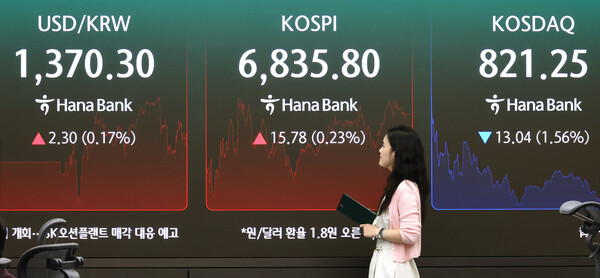
[DigitalToday reporter Sangyeop Oh (오상엽)] The KOSPI finished trading above the 6,800 level for a second straight session, supported by rebounds in large semiconductor shares such as Samsung Electronics and SK Hynix. It slid to the 6,700 range during the session but erased all losses in afternoon trade and turned higher. The Kosdaq, however, fell more than 1 percent.
On Sept. 1, the KOSPI closed up 15.78 points, or 0.23 percent, at 6,835.80. It held the 6,800 level for two sessions in a row following Aug. 31.
The index opened down 35.73 points, or 0.52 percent, at 6,784.29. It then turned higher as bargain buying flowed into semiconductor stocks, rising as high as 6,857.35.
In the main board market, retail investors sold a net 539.8 billion won, foreigners sold a net 491.9 billion won and institutions sold a net 634.0 billion won. All investor groups have been net sellers for two straight sessions.
Among the top market-cap stocks, semiconductor shares were strong. Samsung Electronics ended up 0.38 percent at 261,000 won and SK Hynix closed up 1.14 percent at 1,693,000 won.
SK Square rose 2.89 percent, Samsung C&T gained 3.72 percent, Samsung Life climbed 1.14 percent and Samsung Biologics added 0.13 percent.
LG Energy Solution fell 2.91 percent, Samsung Electro-Mechanics dropped 1.92 percent and Hyundai Motor slid 0.74 percent.
The Kosdaq was weak. It closed down 13.04 points, or 1.56 percent, at 821.25.
In the Seoul foreign exchange market, the won-dollar exchange rate was 1,370.20, up 0.70 won from the previous session.
In the securities industry, attention is focused on the fact that last month the Kosdaq rose 15.9 percent while the KOSPI gained 3.4 percent, with gains spreading beyond blue chips.
Han Ji-young (한지영), a researcher at Kiwoom Securities, said, "It was a market in which a positive rotation developed as not only a handful of large-cap stocks drew flows, but other sectors also reacted to individual catalysts." She added, "There is a high possibility that this kind of market tone will be maintained going forward."
This week, South Korea's exports, U.S. jobs data and moves in long-term U.S. interest rates are cited as market variables. Changes in third-quarter corporate earnings forecasts and results from U.S. semiconductor firms are also expected to affect flows and investor sentiment in domestic semiconductor shares.
 Sangyeop Oh (오상엽)
yub@d-today.co.kr
Sangyeop Oh (오상엽)
yub@d-today.co.kr