
[DigitalToday reporter Chi-gyu Hwang] "The era in which users go looking for data is over. Now data comes looking for users."
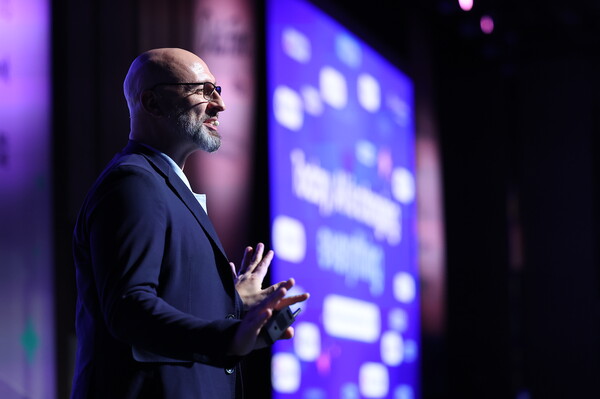
Matthew Miller (매튜 밀러), vice president for global Tableau product management at Salesforce, described the current moment as an era of "agentic analytics" in which users no longer search for insights and insights reach users first. He made the remarks in a keynote speech at Salesforce Korea's annual AI and data conference, "DataFam Seoul 2026," held at the Grand InterContinental Seoul Parnas in Samseong-dong, Seoul.
Miller said that analysis in the past relied on people directly using tools such as Tableau to understand data. By contrast, AI agents identify what users need and remember how they work. AI agents can also adapt on their own to different terminology and ways of thinking across organisations.
He said agentic analytics goes a step further to include a level at which agents proactively find new insights.
He summarised agentic analytics in three stages. The first is a shift from passive to active analysis. Next is a shift from descriptive analytics that simply shows numbers to more advanced analysis. The last is changing analysis that once required a doctorate in statistics to understand into analysis that anyone can understand in their own language.
Miller stressed that "data alone does not complete an insight" and that sound judgment requires the context of documents written by a boss and conversations in collaboration tools.
He added that the same word, "conversion rate," can mean the share of leads that become customers in a marketing organisation, while in a finance organisation it refers to a currency conversion rate. He said agents also need to learn that context because each organisation accumulates different contexts and knowledge.
Miller presented two pillars for Tableau to support such proactive analytics: a Knowledge Engine and a Decision Engine. He said the two work together to complete a structure in which agents present insights first rather than waiting for user questions.
The Knowledge Engine handles data connections and interpretation of meaning. Miller said it includes not only structured enterprise data but also unstructured and semi-structured data such as PDF, CSV and personally managed Excel files. He said it can also assign meaning to both standard data models that have passed government certification and data created on a temporary basis.
He also highlighted knowledge assets already accumulated in Tableau, saying the Knowledge Engine supports agents in understanding organisational context based on such information.
The Decision Engine focuses on producing proactive and intelligent insights. Miller said the Decision Engine includes not only visualisation but also statistical models, machine learning and an execution layer that translates insights into actual actions.
At the event, three sessions that followed the keynote shared Tableau adoption cases by major South Korean companies including Olive Young, LG CNS, Toss Bank, Krafton and Baropharm.
Olive Young introduced a case in which it built a business-led data utilisation culture based on Self-Service Analytics and developed it into a Tableau MCP-based AI Data Agent. Olive Young increased data consistency in the AI-use process based on validated data and enabled employees to immediately check information needed for tasks such as comparing sales by period or analysing performance using natural language in work environments such as Slack.
LG CNS introduced an analytics environment that supports data-driven decision-making by integrating procurement data with ERP and internal and external data. Toss Bank shared cases of advancing an automation experience accumulated by operating about 5,700 dashboards and 362 projects, as well as its data lineage and access-rights management system.
Krafton stressed the importance of data governance to manage business indicators and context consistently. Baropharm disclosed a case in which it increased the efficiency of analysing pharmaceutical data through Tableau-based data preprocessing.
The event also introduced various strategies that analysts use to advance problem definition, indicator design, result verification and decision-making. Salesforce demonstrated the full process, from data preparation to analysis and dashboard building, using natural language with the Tableau Agent. It also introduced an agentic analytics workflow that connects analysis to execution by linking Salesforce and Slack and connecting to external LLMs and AI agents such as Claude Code based on the Tableau MCP (Model Context Protocol).
Young-kyun Kim (김영균), head of Tableau business at Salesforce Korea, said, "As AI enables anyone to quickly analyse data and obtain answers, corporate competitiveness does not come simply from having more data or performing more sophisticated analysis." He added, "A new standard for data capability will be how quickly and accurately insights can be translated into action, based on trustworthy data and clear business context."
He added, "The role of agentic analytics is now expanding beyond simply showing past status to proposing the next action and supporting execution in actual work." He also said, "Salesforce and Tableau will spare no support needed so that the AI transition of South Korean companies can lead to tangible business results by adding trust and context to enterprise data."
 Chi-gyu Hwang
delight@d-today.co.kr
Chi-gyu Hwang
delight@d-today.co.kr