
Critics say an enforcement decree under a special law to expand the national power grid to supply semiconductor industrial parks is only half complete because it lacks criteria for how much of the project cost the state will pay.
Article 25 of the law says the state can support all or part of development project costs as set by a presidential decree, but the current enforcement decree has no provision to implement it. The scope and procedures for the state’s share have not been set, leaving it to rely on other laws or wait for a basic plan.
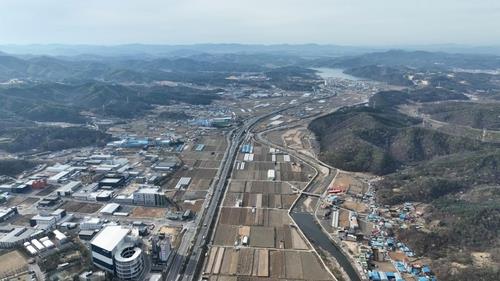
The Ministry of Climate, Energy and Environment, the Jeonnam-Gwangju Integrated Special City, Korea Electric Power, Samsung Electronics and SK Hynix on Aug. 12 signed three agreements to ensure timely power supply for semiconductor industrial parks. The Yongin Advanced System Semiconductor national industrial park, where Samsung Electronics fabs will be built, and a general industrial park semiconductor cluster, where SK Hynix fabs will be established, are expected to need a total of 14 gigawatts by 2041. Based on a capacity of 1.4 gigawatts for the latest large nuclear power plant, that is equivalent to 10 reactors. For the Honam industrial parks, which need more than 6 gigawatts, 3 gigawatts will be supplied first in 2029.
The government decided that the cost of first-stage power supply facilities for the Honam industrial parks will be shared by the public and private sectors according to the proportion of electricity use. It is pushing a plan to provide fiscal support for part of the private contribution under the Special Act on Semiconductors. The structure draws the funding basis from the semiconductor support law rather than the power-grid expansion law, which is the underlying law for the grid project.
The ministry said on July 29 at a public briefing at the Cheong Wa Dae guesthouse that Samsung Electronics, SK Hynix and Amkor will invest a total of 896 trillion won in the Gwangju-Jeonnam southwest region to build four memory fabs and other facilities. Climate, Energy and Environment Minister Sung-hwan Kim (김성환) said that day it would supply 6.3 gigawatts of power and 650,000 tons of water a day to the southwest region on time. President Jae-myung Lee (이재명) said the government would be responsible for power and water among national industrial park infrastructure.
But there is currently no provision in the enforcement decree of the power-grid expansion law corresponding to Article 25, which allows state support for development project costs. The decree does not set the scope of state funding for building transmission lines and substations, or the procedures for applying and executing it. While compensation standards for residents have been set down to specific amounts, the cost-sharing standard for project expenses is left only as a clause.
The enforcement decree also includes compensation standards for residents and local governments, down to specific amounts. It provides fiscal support to local governments where overhead transmission lines pass, up to 2 billion won per kilometre. It allows regional support payments to be increased by up to 3.5 times for nearby areas within 300 metres of national power grid facilities and for dense areas with at least two facilities of 345,000 volts or higher. Chapter 5 of the decree, which covers matters from land purchases to fiscal support for local governments along overhead transmission line routes, all reflects provisions on compensation for residents and local governments under Articles 21 to 24 of the law.
Criteria for state support for development project costs are expected to be filled in through revisions to the enforcement decree or during the process of drafting a basic plan. The climate, energy and environment minister must draw up a basic plan for expanding the national power grid every 5 years, with a 30-year long-term outlook, and the enforcement decree says the plan must be completed by Dec. 31 of the year before the plan begins. The basic plan must include matters on raising funds and investment direction to expand investment needed for grid expansion.
The basic plan is then finalised after collecting opinions through a public hearing and deliberation by the National Power Grid Expansion Committee under the prime minister. Once finalised, the climate, energy and environment minister must report it to a relevant standing committee of the National Assembly. It provides a channel for the National Assembly to examine funding plans to supply 14 gigawatts for Yongin and more than 6 gigawatts for Honam.
If the support criteria under Article 25 are not filled in through revisions to the enforcement decree or during the drafting of the basic plan, the state share of power-grid project costs will ultimately have to depend on case-by-case agreements and other laws. An industry official said, "The Special Act on Semiconductors is aimed at supporting semiconductors, so compared with the power-grid expansion law, the scope of support for industrial parks or companies could narrow."
 Daegeon Seok
d2dg@d-today.co.kr
Daegeon Seok
d2dg@d-today.co.kr