
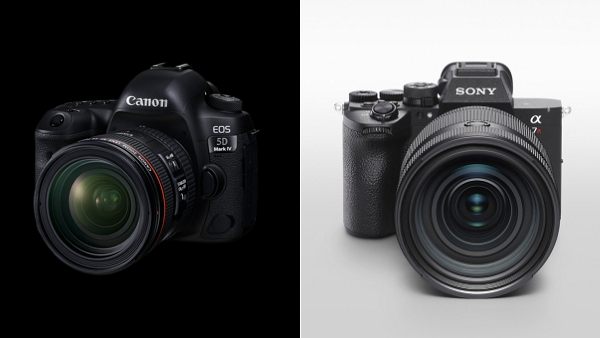
[Digital Today reporter Choi Jae-won] An analysis says consumers buying their first interchangeable-lens camera may be better off choosing mirrorless models rather than DSLRs. That is because most of the latest autofocus and video technologies, as well as new lens development, are concentrated on mirrorless systems.
On Aug. 18, IT media outlet Engadget said the key criteria for a first camera purchase include not only brand, budget and lenses, but also whether to choose DSLR or mirrorless. It said mirrorless lineups are now broadly built out, from entry-level APS-C to professional full-frame, and assessed that mirrorless is a simpler choice for most beginners.
The biggest difference between the two approaches is internal structure. A DSLR reflects light entering through the lens off an internal mirror and sends it to an optical viewfinder. When the shutter is pressed, the mirror flips up and the image sensor receives the light to record a photo. Mirrorless cameras remove the mirror, send light directly to the sensor, and display what the sensor captures on a rear screen or an electronic viewfinder.
With mirrorless, the sensor is always reading the scene, allowing autofocus across a wide area of the frame. It can also automatically recognize subjects such as a person's eyes, animals and cars. It is easy to check exposure changes before shooting, and using an electronic shutter enables fast continuous shooting without mirror movement. Another advantage for beginners is that the viewfinder image is close to the actual result.
DSLRs also have strengths. An optical viewfinder generally offers longer battery life because it does not require the screen to remain on. Image quality is not lower simply because a camera is a DSLR. With a good sensor and lens, both DSLRs and mirrorless cameras can produce strong results. The explanation is that mirrorless advantages are clearer in autofocus, burst shooting, video recording and overall ease of use than in pure image quality.
Mirrorless is not always overwhelmingly smaller. The body can be made smaller because there is no mirror, but when a large telephoto lens is attached, differences in overall system size and weight narrow significantly.
If you already use a DSLR, the decision changes. If users who own several Canon EF or Nikon F lenses are satisfied, there is little reason to immediately switch to mirrorless at huge cost. Another option is to use existing lenses on mirrorless via an adapter. DSLRs also retain an advantage in that they can be bought relatively cheaply on the secondhand market.
Still, if you are building a new system for the first time, the market direction is clearly toward mirrorless. Engadget said about 90 percent of interchangeable-lens camera shipments in 2025 were mirrorless. Nikon is also expanding its Z mirrorless lineup without releasing a new DSLR since the D6 in 2020.
DSLRs are still cameras that can take sufficiently good photos, but the assessment is that consumers setting up their first camera and lens system in 2026 may find it more reasonable to choose mirrorless when considering future new products, lenses and technical support.
 Choi Jae-won
ittt_0801@d-today.co.kr
Choi Jae-won
ittt_0801@d-today.co.kr