
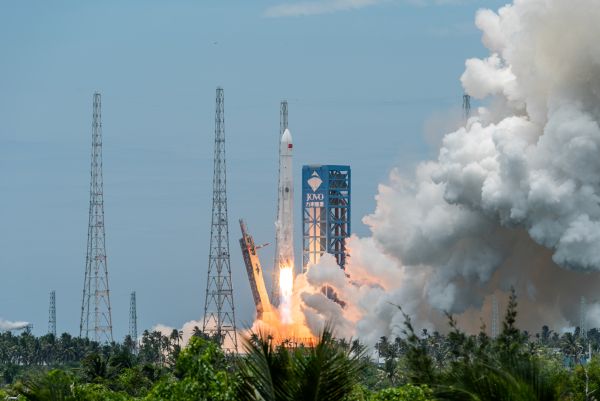
[DigitalToday intern reporter Seung-a Yoo] China is set to launch Chang'e 7 as early as this Sunday and attempt a landing at Shackleton crater near the moon's south pole. If successful, it could become a symbolic turning point in the U.S.-China space race by securing data from a key region of the lunar south pole ahead of the United States' plan to return humans to the moon, IT outlet Ars Technica reported on Aug. 18 (local time).
Chang'e 7 is to be launched aboard a Long March 5 (CZ-5) rocket from a coastal launch site in China. It is considered the most sophisticated mission among China's lunar exploration program, which has continued for nearly 20 years. The orbiter carries precision equipment such as a high-resolution camera. It also carries a lander, a rover and a small hopping probe. The lander's mass has not been officially disclosed, but it was reported to be several times larger than NASA-supported probes such as Firefly's Blue Ghost, which recently landed on the moon.
The main focus is the landing site. Shackleton crater, the target area, is very close to the moon's south pole and is regarded as one of the most valuable zones in discussions about building a long-term lunar base. While most of the lunar surface is barren terrain, the south pole region, especially around Shackleton crater, is seen as the most coveted site.
That is because high terrain along the crater's rim creates permanently shadowed regions where sunlight never reaches. This area, known as a "cold trap", has long been cited as a place where water in the form of ice and other useful materials could have accumulated over billions of years. It is the backdrop to why a few limited areas of the lunar south pole are regarded as the most important strategic assets as both the United States and China envision long-term habitation footholds.
Humanity's lunar exploration began in 1959 when the former Soviet Union's Luna 1 passed within several thousand kilometres of the moon's surface. More than 100 successes and failures followed, but no spacecraft has ever landed at the moon's south pole. In that sense, images of a Chinese rover driving through the region, which has effectively remained unexplored, carry symbolic weight. If the mission succeeds, it will also secure the most direct data on whether water exists in the region and how it is distributed, along with striking footage.
The significance extends beyond science into geopolitics. In the United States, there is a view that because Apollo 11 landed humans on the moon about 60 years ago and won the space race, China's push for a crewed lunar landing only underscores how great the U.S. achievement was at the time. There is also a view that in the 21st century China has risen economically and geopolitically to form a two-power rivalry with the United States, and that space is one arena of that competition. Under that view, if China lands humans on the moon before the United States, it could be a huge geopolitical victory, and in propaganda terms could provide grounds for China to claim it has not merely caught up to the United States but has surpassed it as this century's superpower.
This month brings the first test of which of these two views is correct.
This situation could also affect public opinion and policy in the United States. Most Americans do not strongly feel the U.S.-China space race, but there is a view that if footage is released showing Chinese hardware driving across the moon's south pole, questions could intensify over why China can do it and NASA cannot.
The U.S. Congress has already begun to respond. Early this year, Congress granted broad discretion to NASA's new administrator, Jared Isaacman (재러드 아이작먼), to overhaul the overall lunar program. That included ending development of the Lunar Gateway space station and stopping development of an unnecessary upper stage for the Space Launch System rocket. This is interpreted as a major concession by Congress that effectively allows a different approach from the previous leadership, after NASA was seen as having been more interested in preserving jobs and programs than in results. Isaacman still faces a tough task. He must put the Artemis program on a normal track while also countering China's lunar strategy.
How China uses a Chang'e 7 success is also a variable. Among several options, one that stands out is a plan to set up what would effectively be an exclusion zone aimed at NASA, based on the areas the rover actually traverses.
That could be seen as a clear provocation to the United States. It could also add momentum to calls to increase investment in Artemis and accelerate its schedule, and it could result in Isaacman gaining greater political momentum to push NASA reforms. There is also analysis that it could prompt those who have not seen it as a major problem for China to return to the moon before NASA to reconsider.
 Seung-a Yoo
ysah@d-today.co.kr
Seung-a Yoo
ysah@d-today.co.kr