
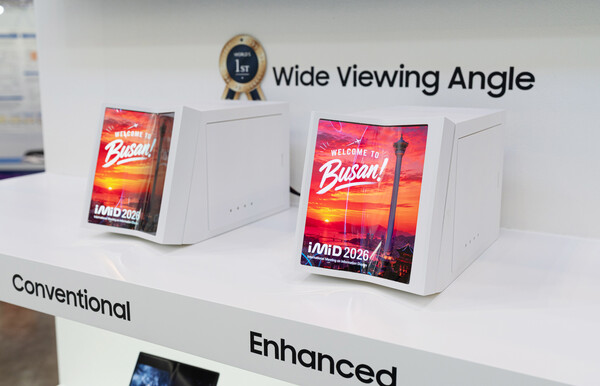
Two of South Korea's biggest display makers are unveiling next-generation OLED technologies in a race for technological leadership. Samsung Display and LG Display take part in IMID 2026 held at BEXCO in Busan on Aug. 19 and simultaneously unveil new next-generation OLED technologies, including wide-viewing-angle foldables and pixel patterning without an FMM.
Samsung Display's "Wide View" display, unveiled for the first time at the show, is a 7.6-inch wide-viewing-angle OLED for mobile devices. Currently commercialised foldable displays have seen brightness on the curved surfaces on both sides of the central fold stay at about 40 percent of the front-facing level. Samsung Display says it completely redesigned the materials and structure of the organic light-emitting layer to deliver uniform image quality on curved sections without a drop in luminance. A company official explained that it can deliver uniform image quality across next-generation form factors such as foldable, slideable and rollable displays without brightness differences depending on viewing angle.
Samsung Display also presented the world's largest 20-inch wide stretchable display. It applied a tiling technology that connects two existing stretchable panels as if they were a single screen, expanding the screen size to more than double the previous level. It minimised the boundary between the two panels through ultra-precise panel design and module lamination technology, and it aims to apply the technology to automotive digital cockpits and humanoid and digital signage fields.
LG Display unveiled for the first time in the world its next-generation OLED patterning technology, FLiPP (FMM-Less innovative Pixel Patterning), which forms pixels without an FMM. An FMM is a metal mesh with tiny holes and has been used as a standard process for OLED pixel manufacturing, but it has had structural limits: an expensive mask must be replaced whenever size or resolution changes, and colour defects can occur when scaling up due to metal sagging.
FLiPP patterns pixels by coating and fixing red, green and blue subpixels across the entire substrate and then removing unnecessary parts using UV light. Compared with FMM, its aperture ratio improves by 55 percent. Based on that, it can increase luminance by 1.6 times, extend lifespan by 2.4 times, or reduce power consumption by 13 percent.
The two companies each won the IMID Display of the Year Grand Prize at this year's IMID. Samsung Display won for an OLED for the Galaxy S26 Ultra that is the first in the world to feature a privacy display, while LG Display won for HDS (Hyper Double Scanning), which doubles data transmission speed and raises OLED TV panel refresh rates from 144Hz to 165Hz.
Samsung Display presented 57 technical papers, the most among participating companies, to disclose its research and development results. Seongchan Cho (조성찬), head of the Display Research Center and a vice president, presented three directions for displays demanded by the AI era in a keynote speech at the opening ceremony on Aug. 19: "Every Space" applied to all spaces, "Ultra Low Power" for low-power operation, and "Context Awareness" combining sensors and AI.
Youngseok Choi (최영석), LG Display's chief technology officer, said it had succeeded in implementing FLiPP, a next-generation OLED patterning technique called a "dream technology," by consolidating its proprietary WOLED technologies and know-how. He said the company would use its participation in this year's IMID as a momentum to lead next-generation OLED technology and accelerate market differentiation.
 Seok Dae-geon
d2dg@d-today.co.kr
Seok Dae-geon
d2dg@d-today.co.kr