
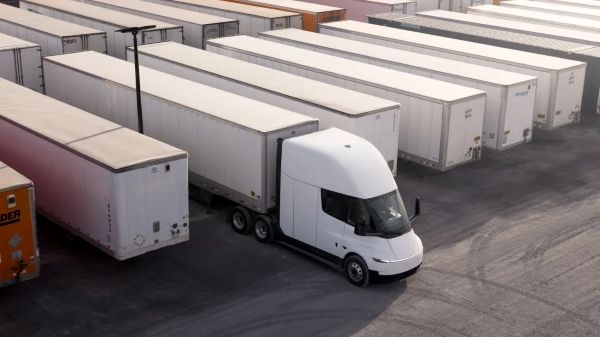
Swedish electric and autonomous trucking company Einride (Einride) will add 500 Tesla Semis to expand its North American freight business. It is the largest disclosed contract related to the Tesla Semi so far.
On Aug. 18, TechCrunch and other foreign media reported that the deal will increase Einride's operating fleet to about 750 vehicles from about 250. Initial deliveries will start in September, with the remaining units deployed sequentially over 24 months. Einride disclosed the contract alongside its first-half results. The covered area is five states: California, Texas, New Jersey, Illinois and Georgia, and Amazon is named as a customer. All vehicles will be integrated and operated through Einride's dispatch and charging management software, Saga.
Before this deal, the largest Tesla Semi order was by WattEV, which placed an order in May for 370 units for port freight transport in California. Einride exceeded WattEV's record by 130 vehicles with this contract.
Einride Chief Executive Roozbeh Charli (루즈베 차를리) said, "This introduction is another proof that we can execute at the scale customers demand." Dan Priestley (댄 프리즐리), Tesla's director in charge of the Semi, said, "Electric heavy-duty trucks lower cost per mile through fuel savings compared with diesel trucks, reduced maintenance, and improved uptime."
Looking at the cost structure, the math is not simple. Based on pricing disclosed when the Tesla Semi first rolled off a high-volume production line in April, the long-range Semi with a 500-mile (about 805 km) range per charge was priced at about $290,000 (about 410 million won), and the standard-range version at about $260,000 (about 370 million won). Based on 500 vehicles, hardware costs alone amount to about $130 million to $145 million (about 184 billion won to about 210 billion won).
By contrast, Einride had about $77 million (about 110 billion won) in cash as of the end of June. In a press release, the company explained the gap in a single sentence, saying it was "fully financed through third-party financing," but it did not disclose the lenders or terms, or whether the vehicles will be recorded as assets on Einride's financial statements. This alone is not necessarily a warning sign. Asset financing for Class 8 equipment is already a mature business area, and Einride's business model is designed so shippers do not take capital risk. Still, some point out that, as support for a nine-figure contract, it relies heavily on a single sentence with an unclear source.
The figure of $800 million (about 1.13 trillion won) also needs to be examined in the same context. Einride described the contract as work to convert "potential long-term annual recurring revenue of about $800 million under joint business plans" into actual freight-transport capacity. The $800 million appears in Einride's first-half report in the same way as potential annual recurring revenue under joint business plans that has not yet been converted. That means it is still at the pipeline stage, not confirmed order backlog.
Tesla's situation is relatively straightforward. The Semi factory next to the Nevada Gigafactory was built with an annual capacity of 50,000 units, and has ramped up operations since April. Analysts projected 2026 deliveries at 5,000 to 15,000 units, and there are also claims that these forecasts are overly optimistic. In this situation, a single customer introducing 500 vehicles at once on recurring routes across five states is an "anchor deployment" that could support the economics of building Megacharger charging infrastructure. Concentrated routes are more advantageous than scattered pilot projects in terms of infrastructure investment efficiency.
There is also an interesting point. Einride is a company known for its cabless autonomous pod trucks, and the 500 Semis it is buying from Tesla were designed from the outset with autonomous driving in mind. Elon Musk said in July that full self-driving for the Semi was about 1 year away. Einride's strategy can ultimately be summed up as placing its own intelligent software layer on top of another company's hardware.
Tesla's Semi business has not been smooth. After first unveiling the concept in 2017, the launch was delayed several times due to COVID-19 and the fallout from global supply shortages, and it delivered the first units to customers such as PepsiCo only in 2022. The shift to mass production was then delayed again, and the first Semi from the Nevada plant's high-volume production line came in April 2026. Despite these recent achievements, Tesla has stepped back from its previous promise to achieve "full-scale mass production" within 2026. The company said in its second-quarter shareholder letter and earnings report that it is focusing on expanding production of 4680 battery cells to produce the Semi and Cybercab at scale.
Einride listed in June and currently operates about 200 of its own medium and heavy-duty electric trucks for clients including Heineken and PepsiCo. It has also developed its own cabless autonomous pod trucks, and the Saga software integrates management of operations, routing and charging across all these vehicles. The Tesla contract is significant for Einride. It triples vehicle scale while strengthening the sales case for the Saga software. Einride said it plans to provide the Tesla Semis it is introducing to customers across North America and expand an electric freight network along key logistics corridors including California, Georgia, New Jersey and Texas.
Founded 10 years ago, Einride has developed multiple elements of its business over a long period, including software, electric trucks and unmanned autonomous trucks, and has noticeably increased the pace of expansion in 2026. It signed a contract with Amazon to add 75 medium and heavy-duty electric trucks to Amazon's Relay freight network and to provide charging infrastructure at five U.S. hubs. It also acquired EV charging company Flipturn, building a system to provide electric trucks together with charging software.
 Seungah Yoo
ysah@d-today.co.kr
Seungah Yoo
ysah@d-today.co.kr