
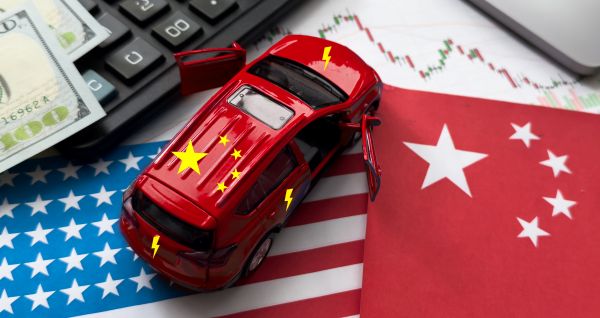
Chinese-made cars could enter the U.S. market faster than expected, a projection said.
As of Aug. 17 local time, EV outlet CleanTechnica reported that inflows via Mexico and Canada, Waymo’s adoption of China-made vehicles and price competitiveness are combining to boost the presence of Chinese cars in the United States.
The most notable move is by Waymo. Waymo is bringing in Zeekr Ohai minivans produced in China for its robotaxi fleet. The vehicles are manufactured in China and then fitted with Waymo’s latest autonomous driving technology in Mesa, Arizona. Waymo judged the cost to be lower than the Jaguar I-Pace SUVs it previously used, even while paying 127.5 percent tariffs per vehicle.
The Zeekr Ohai uses a sixth-generation advanced driver assistance system. Its sensor setup includes 13 cameras, 4 lidars and 6 radars, focusing on cutting hardware costs. The vehicle design also features sliding doors on both sides, a low step-in height, a flat floor and 3 rear-seat touchscreens, highlighting passenger convenience.
Changes are also appearing along the U.S. northern border. Canada has begun importing Chinese-made EVs on the scale of 50,000 vehicles a year under a new agreement between the two countries. Once these vehicles are formally registered on Canadian roads, they can legally drive on U.S. roads as well. To the south, the report also cited cases in which BYD vehicles with Mexican plates were frequently spotted around San Diego.
The U.S. auto industry is also openly discussing the possibility of Chinese cars entering the market. Jim Farley (짐 팔리), chief executive of Ford (Ford), said two weeks ago to internal staff that Chinese cars were likely to enter the United States within 5 to 10 years and that the company should prepare. Yale Zhang (예일 장), head of Automotive Foresight (Automotive Foresight), said the United States cannot block Chinese cars forever and that U.S. automakers could face complaints from consumers that they should be able to enjoy reasonably priced smart EVs. He added that such pressure would grow if consumers in Mexico and Canada accept EVs with strong performance and price competitiveness.
The price gap is cited as a backdrop to that outlook. UBS said in an April report that Chinese EVs would enter the U.S. market in the medium to long term despite high tariffs. According to a 2023 UBS report, BYD’s EV manufacturing costs were 35 percent lower than those of Western competitors due to Chinese automakers’ supply chains and related technological competitiveness.
Cui Shudong (추이수둥), secretary general of the China Passenger Car Association, said the average price of new EVs in China in the first half of 2026 was $36,605. Based on Kelley Blue Book, the average U.S. EV price as of February was $55,300, and the average price of new internal combustion engine cars was $48,800. From the perspective of U.S. consumers, the large price gap is cited as a factor that could increase pressure for Chinese cars to enter the market.
Chinese companies are also not fully closing off the possibility of the U.S. market. Geely said in May that, at the group level holding Zeekr, Volvo and Polestar, it does not rule out entering the United States and would make a decision within 3 years. In the short term, however, both Chinese companies and U.S.-China joint ventures are maintaining a cautious stance on direct entry into the U.S. market.
Stella Li (스텔라 리), BYD’s head of international business, said in July that it can achieve its goal of becoming global No. 1 even if it does not sell cars in the United States. That means targeting the U.S. market is not an absolute task right now. Even so, if indirect exposure through Mexico, Canada and robotaxi operations increases, consumer touchpoints in the United States could continue to expand.
Ultimately, the issue is how much U.S. tariffs and security regulations can delay inflows of Chinese cars. Even if the U.S. government blocks direct sales, the possibility remains that China-made vehicles could first build a presence on U.S. roads through neighboring markets and the introduction of commercial vehicles. If price competitiveness and product appeal are maintained, discussion of Chinese cars entering the U.S. market could accelerate.
 Seung-a Yoo
ysah@d-today.co.kr
Seung-a Yoo
ysah@d-today.co.kr